
Eliza Cook
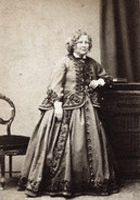

Eliza Cook Poems
THREE summers have gone since the first time we met, love,
And still 'tis in vain that I ask thee to wed ;
I hear no reply but a gentle " Not yet, love,"
With a smile of your lip, and a shake of your head.
...
HE crawls to the cliff and plays on a brink
Where every eye but his own would shrink;
No music he hears but the billow’s noise,
And shells and weeds are his only toys.
...
I LOVE it, I love it ; and who shall dare
To chide me for loving that old Arm-chair ?
I've treasured it long as a sainted prize ;
I've bedewed it with tears, and embalmed it with sighs.
...
I leave thee for awhile, my love, I leave thee with a sigh;
The fountain spring within my soul is playing in mine eye;
...
I gazed on orbs of flashing black;
I met the glow of hazel light;
I marked the hue of laughing blue,
That sparkled in the festive night.
...
Bring the Harp of the West, and the Pipes of the North,
When our Trumpet note calls to the field;
Let the men of old Scotia and Erin come forth,
And our foemen shall see who must yield
...
THE worm, the rich worm, has a noble domain
In the field that is stored with its millions of slain ;
The charnel-grounds widen, to me they belong,
With the vaults of the sepulchre, sculptured and strong.
...
I never see a young hand hold
The starry bunch of white and gold,
But something warm and fresh will start
About the region of my heart; -
...
THE ORB I like is not the one
That dazzles with its lightning gleam;
That dares to look upon the sun,
As though it challenged brighter beam.
...
Be kind when you can, though the kindness be little,
'Tis small letters make up philosophers' scrolls;
The crystal of Happiness, vivid and brittle,
Can seldom be cut into very large bowls.
...
TURPIN had his Black Bess, and she carried him well,
As fame with her loud-breathing trumpet will tell;
She knew not the lash, and she suffered no spur;
A bold rider was all that was needed by her.
...
We know 'tis good that old Winter should come,
Roving awhile from his Lapland home;
'Tis fitting that we should hear the sound
...
Cheer up, cheer up, my mother dear!
Ah! Why do you sit and weep?
Do you think that he who guards me here,
Forsakes me on the deep?
...
I've come to the cabin he danced his wild jigs in,
As neat a mud palace as ever was seen;
...
Tis the streamer of England - it floats o'er the brave-
'Tis the fairest unfurled o'er the land or the wave;
But though brightest in story and matchless in fight,
'Tis the heralds of Mercy as well as of Might.
...
Eliza Cook Biography
Eliza Cook was an English author, Chartist poet and writer born in London Road, Southwark Background She was the daughter of a local tradesman. She attended the local Sunday Schools and was encouraged by the son of the music master to produce her first volume of poetry. From this she took confidence and in 1837 began to offer verse to the radical Weekly Dispatch, then edited by William Johnson Fox. She was a staple of its pages for the next ten years. She also offered material to The Literary Gazette, Metropolitan Magazine and New Monthly. Work Her work for the Dispatch and New Monthly was later pirated by George Julian Harney, the Chartist, for the Northern Star. Familiar with the London Chartist movement, in its various sects, she followed many of the older radicals in disagreeing with the O'Brienites and O'Connorites in their disregard for repeal of the Corn Laws. She also preferred the older Radicals' path of Friendly Societies and self-education. In 1835 while only seventeen years of age she published her first volume titled Lays of a Wild Harp. In 1838 she published Melaia and other Poems, and from 1849 to 1854 wrote, edited, and published Eliza Cook's Journal, a weekly periodical she described as one of "utility and amusement." Cook also published Jottings from my Journal (1860), and New Echoes (1864); and in 1863 she was given a Civil List pension income of £100 a year. Her poem The Old Armchair (1838) made hers a household name for a generation, both in England and in America. Cook was a proponent of political and sexual freedom for women, and believed in the ideology of self-improvement through education, something she called "levelling up." This made her great favourite with the working-class public. Her works became a staple of anthologies throughout the century. She died in Wimbledon.)
The Best Poem Of Eliza Cook
Don'T Tell The World That You'Re Waiting For Me
THREE summers have gone since the first time we met, love,
And still 'tis in vain that I ask thee to wed ;
I hear no reply but a gentle " Not yet, love,"
With a smile of your lip, and a shake of your head.
Ah ! how oft have I whispered, how oft have I sued thee,
And breathed my soul's question of " When shall it be ?"
You know, dear, how long and how truly I've wooed thee,
So don't tell the world that you're waiting for me.
I have fashioned a home, where the fairies might dwell, love,
I've planted the myrtle, the rose, and the vine ;
But the cottage to me is a mere hermit's cell, love,
And the bloom will be dull till the flowers are thine.
I've a ring of bright gold, which I gaze on when lonely,
And sigh with Hope's eloquence, " When will it be ?"
There needs but thy " Yes," love--one little word only,
So don't tell the world that you're waiting for me.
Eliza Cook Comments
There is another Poem I believe by the same Eliza Cook from this period called Building Upon the Sand - a piece the that both convicts and inspires.
As a child I purchased one of Eliza Cook's poetry books for 1 old penny at a jumble sale and still have it today. I learnt by heart and performed ' The Mouse and the Cake' one Christmas to my family, all of us would perform either a song, poem, some magic for the adults when we all got together as a family.




Delivering Poems Around The World
Poems are the property of their respective owners. All information has been reproduced here for educational and informational purposes to benefit site visitors, and is provided at no charge...
10/7/2026 5:16:31 AM # rel_20260925T122446Z_7d6ee41



nice peom