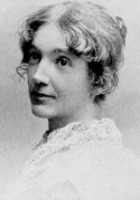

Ethelwyn Wetherald Biography
Agnes Ethelwyn Wetherald was a Canadian poet.
She was born at Rockwood, Ontario, the daughter of Rev. William Wetherald, a Quaker minister. She was educated at the Friends' Boarding School in Union, New York, and at Pickering College. She sold her first poem to St. Nicholas Magazine at 17, and soon was contributing to many publications throughout Canada and the United States, including The Globe, The Week, and Rose-Belford's Canadian Magazine. She co-wrote a novel, An Algonquin Maiden (1887), with Graeme Mercer Adam, and in 1895 published her first volume of poetry.
She worked for several decades as a proofreader, journalist, and editorial assistant at newspapers in Ontario and the north-eastern United States. For a time she 'conducted the Women's Department' of the under the pseudonym "Bel Thistlethwait." She adopted a child, Dorothy, in 1911 when she was 54, and in 1921 published a book of children's verse, Tree-Top Mornings, dedicated to Dorothy.
Reviewing her 1907 book, The Last Robin, The Globe pronounced: "The salient quality of Miss Wetherald's work is its freshness of feeling, a perennial freshness, renewable as spring. This has a setting of harmonious form, for the poet's ear is delicately attuned to the value of words, both as to the sound and the meaning.... The sonnets are an important part of the volume, and, to some minds, will represent the most important part. Miss Wetherald's sonnets are flowing in expression and harmonious in thought; some are beautiful."
The Dictionary of Literary Biography calls the best of her poems "musical, restrained, and precise," and "equal to much of the work of her better-known Canadian contemporaries such as Archibald Lampman, Bliss Carman, and Duncan Campbell Scott." On occasion, it adds, "her themes and images recall the poetry of Emily Dickinson."
The Great soft downy snow storm like a cloak
Descends to wrap the lean world head to feet;
It gives the dead another winding sheet,
...
With slender arms outstretching in the sun
The grass lies dead;
The wind walks tenderly and stirs not one
Frail fallen head.
...
When I see,
High on the tip-top twig of a tree,
Something blue by the breezes stirred,
But so far up that the blue is blurred,
...
Muck of the sty, reek of the trough,
Blackened my brow where all might see,
Yet while I was a great way off
...
I saw a mother holding
Her play-worn baby son,
Her pliant arms enfolding
The drooping little one.
...




Delivering Poems Around The World
Poems are the property of their respective owners. All information has been reproduced here for educational and informational purposes to benefit site visitors, and is provided at no charge...
4/11/2026 7:11:27 AM # 1.0.0