
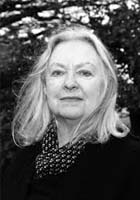

Gillian Clarke Biography
Gillian Clarke (born 8 June 1937) is a Welsh poet, playwright, editor, broadcaster, lecturer and translator from Wales.
Gillian Clarke was born on 8 June 1937 in Cardiff, and was brought up in Cardiff and Penarth, though for part of the Second World War she was in Pembrokeshire. She lived in Barry for a few years at a house called "Flatholme" on The Parade. Although her parents were Welsh speakers, she was brought up speaking only English and learnt to speak Welsh as an adult - partly as a form of rebellion. She graduated in English from Cardiff University.
Afterwards she spent a year working for the BBC in London.
She then returned to Cardiff, where she married and had a daughter, Catrin, about whom she has written a poem of the same name, and two sons. She worked as an English teacher, first at the Reardon-Smith Nautical College and later at Newport College of Art.
In the mid-1980s she moved to rural Ceredigion, west Wales with her second husband, after which time she spent some years as a creative writing tutor at the University of Glamorgan.
In 1990 she was a co-founder of Ty Newydd, a writers' centre in North Wales.
Her poetry is studied by GCSE and A Level students throughout Britain. She has given poetry readings and lectures in Europe and the United States, and her work has been translated into ten languages. A considerable number of her poems are used in the GCSE AQA Anthology.
Clarke has published numerous collections of poetry for adults and children (see below), as well as dramatic commissions and numerous articles in a wide range of publications. She is a former editor of The Anglo-Welsh Review (1975–84) and the current president of Tŷ Newydd. Several of her books have received the Poetry Book Society Recommendation. In 1999 Gillian Clarke received the Glyndŵr Award for an "Outstanding Contribution to the Arts in Wales" during the Machynlleth Festival, and she was on the judging panel for the 2008 Manchester Poetry Prize. Clarke reads her poetry for teenagers who are taking their English GCSE school exams. She is part of the GCSE Poetry Live team that also includes John Agard, Simon Armitage, Carol Ann Duffy, Imtiaz Dharker, Moniza Alvi, Grace Nichols, Daljit Nagra and Choman Hardi.
In December 2013 Clarke was the guest for BBC Radio 4's Desert Island Discs.
Under the ocean where water falls
over the decks and tilted walls
where the sea come knocking at the great ship's door,
...
You scan the stream, silver-eyed as a heron
searching the surface for what might betray
a halt in the flow, pentameter's delay,
a master's faded words, his lexicon.
...
Snowlight and sunlight, the lake glacial.
Too bright to open my eyes
in the dazzle and doze
of a distant January afternoon.
...




Delivering Poems Around The World
Poems are the property of their respective owners. All information has been reproduced here for educational and informational purposes to benefit site visitors, and is provided at no charge...
4/9/2026 8:22:13 AM # 1.0.0


