
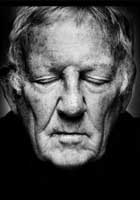

Hugo Maurice Julien Claus Biography
Hugo Claus (1929) has been the wonder boy of Flemish literature for more than half a decade. He has written more than a hundred literary works, with which he has won more than forty literary prizes. To his credit he has poems, stories, novels, plays, libretti and film scripts. He is also renowned as a translator, painter and film director.
Influenced by surrealism, in the nineteen-fifties he made his name as a poet with a number of collections of experimental lyric poetry, of which De Oostakkerse gedichten (The East Acre Poems) (1955) is the highpoint. From the nineteen-sixties onwards topical events became more prominent in his work, which is illustrated by the explicit social commitment in volumes such as Van horen zeggen (Hearsay) (1970). At the same time, he started increasingly to include quotes from and references to other writers and artists.
I am not, I am only in your earth.
When you screamed and your skin quivered
My bones caught fire.
...
Sparse song dark thread
Land like a sheet
That sinks
Springland of hooves and milk
...
Autumn. Listen. Crackling. Can you hear that heavy rattling?
It draws near in our clothes, in our hair.
Lice of sound. What is this leprous mumbling?
Child, its the poets outside, their teeth chattering.
...
Still as the death of a dead man no one knows
it is everywhere but your room
where you're dancing on your own as before.
...
(in 1951,
when Charlie Parker was still alive)
The undulating bars of Avenue des Champs
...




Delivering Poems Around The World
Poems are the property of their respective owners. All information has been reproduced here for educational and informational purposes to benefit site visitors, and is provided at no charge...
3/16/2026 1:24:38 PM # 1.0.0


