
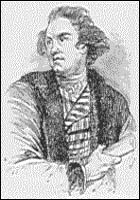

James Macpherson Biography
James Macpherson (Scottish Gaelic: Seumas MacMhuirich or Seumas Mac a' Phearsain) was a Scottish writer, poet, literary collector and politician, known as the "translator" of the Ossian cycle of poems.
Early Life
Macpherson was born at Ruthven in the parish of Kingussie, Badenoch, Inverness-shire. In 1753, he was sent to King's College, Aberdeen, moving two years later to Marischal College (the two institutions later became the University of Aberdeen). He then went to Edinburgh for just over a year, but it is unknown whether he studied at the university. He is said to have written over 4,000 lines of verse while a student; some of this was later published, notably The Highlander (1758), which he is said to have tried to suppress afterwards.
Collecting Scottish Gaelic Poetry
On leaving college, he returned to Ruthven to teach in the school there. At Moffat he met John Home, the author of Douglas, for whom he recited some Gaelic verses from memory. He also showed him manuscripts of Gaelic poetry, supposed to have been picked up in the Scottish Highlands and the Western Isles. Encouraged by Home and others, he produced a number of pieces translated from the Scottish Gaelic, which he reportedly spoke, which he was induced to publish at Edinburgh in 1760 as Fragments of Ancient Poetry collected in the Highlands of Scotland.
Dr. Hugh Blair, who was a firm believer in the authenticity of the poems, raised a subscription to allow Macpherson to pursue his Gaelic researches. In the autumn he set out to visit western Inverness-shire, the islands of Skye, North Uist, South Uist and Benbecula. He obtained manuscripts which he translated with the assistance of a Captain Morrison and the Rev. Gallie. Later he made an expedition to the Isle of Mull, where he obtained other manuscripts.
Ossian
In 1761 he announced the discovery of an epic on the subject of Fingal (related to the Irish mythological character Fionn mac Cumhaill/Finn McCool) written by Ossian (based on Fionn's son Oisín), and in December he published Fingal, an Ancient Epic Poem in Six Books, together with Several Other Poems composed by Ossian, the Son of Fingal, translated from the Gaelic Language, written in the musical measured prose of which he had made use in his earlier volume. Temora followed in 1763, and a collected edition, The Works of Ossian, in 1765. The name Fingal or Fionnghall means "white stranger", and it is suggested that the name was rendered as Fingal through a derivation of the name which in old Gaelic would appear as Finn.
The authenticity of these so-called translations from the works of a 3rd century bard was immediately challenged by Irish historians, especially Charles O'Conor, who noted technical errors in chronology and in the forming of Gaelic names, and commented on the implausibility of many of MacPherson's claims, none of which MacPherson was able to refute. More forceful denunciations were later made by Dr. Samuel Johnson, who asserted (in A Journey to the Western Islands of Scotland, 1775) that MacPherson had found fragments of poems and stories, and then woven them into a romance of his own composition. Further challenges and defences were made well into the nineteenth century, but the issue was moot by then. Macpherson never produced the originals that he claimed existed.
Later Works
In 1764 he was made secretary to the colonial governor George Johnstone at Pensacola, Florida. He returned to Great Britain two years later, and, despite a quarrel with Johnstone, was allowed to retain his salary as a pension.
He went on to write several historical works, the most important of which was Original Papers, containing the Secret History of Great Britain from the Restoration to the Accession of the House of Hanover, to which are prefixed Extracts from the Life of James II, as written by himself (1775). He enjoyed a salary for defending the policy of Lord North's government, and held the lucrative post of London agent to the Nawab of Arcot. He entered parliament in 1780, as Member of Parliament for Camelford and continued to sit for the remainder of his life.
Death
In his later years he bought an estate, to which he gave the name of Belville, in his native Invernessshire, where he died at the age of 59. Macpherson's remains were carried from Scotland and interred in the Abbey Church of Westminster.
Legacy
After Macpherson's death, Malcolm Laing, in an appendix to his History of Scotland (1800), concluded that the so-called Ossianic poems were altogether modern in origin, and that Macpherson's authorities were practically non-existent.
Despite the above some critics claim that Macpherson nonetheless produced a work of art which by its deep appreciation of natural beauty and the melancholy tenderness of its treatment of the ancient legend did more than any single work to bring about the romantic movement in European, and especially in German, literature. It was speedily translated into many European languages, and Herder and Goethe (in his earlier period) were among its profound admirers. Goethe incorporated his translation of a part of the work into his novel The Sorrows of Young Werther. Melchiore Cesarotti's Italian translation was reputedly a favourite of Napoleon.
Macpherson's legacy indirectly includes the naming of Fingal's Cave on the island of Staffa. The original gaelic name is "An Uamh Bhin" ("the melodious cave"), but it was renamed by Sir Joseph Banks in 1772 at the height of Macpherson's popularity.
Macpherson is frequently mentioned along with Thomas Chatterton, another forger of the era, in the 1780 novel Love and Madness by Herbert Croft.
Malvina, the daughter of Toscar, is overheard by Ossian lamenting the death of Oscar her lover. Ossian, to divert her grief, relates his own actions in expedition which he undertook, at Fingal's command, to aid Crothar the petty king of Croma, a country in Ireland, against Rothmar, who invaded his dominions. The story is delivered down thus in tradition. Crothar, king of Croma, being blind with age, and his son too young for the field, Rothmar, the chief of Tromo resolved to avail himself of the opportunity offered of annexing the dominions of Crothar to his own. He accordingly marched into the country subject to Crothar, but which he held of Arth or Artho, who was, at the time, supreme king of Ireland.
Crothar being, on account of his age and blindness unfit for action, sent for aid to Fingal, king of Scotland; who ordered his son Ossian to the relief of Crothar. But before his arrival Fovargormo, the son of Crothar, attacking Rothmar, was slain himself, and his forces totally defeated. Ossian renewed the war; came to battle, killed Rothmar, and routed his army. Croma being thus delivered of its enemies, Ossian returned to Scotland.
...
ARGUMENT.
Cuthullin and Connal still remain on the hill. Fingal and Swaran meet: the combat is described. Swaran is overcome, bound, and delivered over as a prisoner to the care of Ossian, and Gaul, the son of Morni; Fingal, his younger sons and Oscar still pursue the enemy. The episode of Orla, a chief of Lochlin, who was mortally wounded in the battle, is introduced. Fingal, touched with the death of Orla, orders the pursuit to be discontinued; and calling his sons together, he is informed that Ryno, the youngest of them, was slain. He laments his death, hears the story of Lamderg and Gelchossa, and returns towards the place where he had left Swaran. Carril, who had been sent by Cuthullin to congratulate Fingal on his victory, comes in the mean time to Ossian. The conversation of the two poets closes the action of the fourth day.
...
ARGUMENT.
The ghost of Crugal, one of the Irish heroes who was killed in battle, appearing to Connal, foretells the defeat of Cuthullin in the next battle, and earnestly advises him to make peace with Swaran. Connal communicates the vision; but Cuthullin is inflexible; from a principle of honor he would not be the first to sue for peace, and he resolved to continue the war. Morning comes; Swaran proposes dishonorable terms to Cuthullin, which are rejected. The battle begins, and is obstinately fought for some time, until, upon the flight of Grumal, the whole Irish army gave way. Cuthullin and Connal cover their retreat. Carril leads them to a neighboring hill, whither they are soon followed by Cuthullin himself; who descries the fleet of Fingal making towards their coast; but night coming on, he lost sight of it again. Cuthullin, dejected after his defeat, attributes his ill success to the death of Ferda, his friend, whom he had killed some time before. Carril, to show that ill success did not always attend those who innocently killed their friends, introduces the episode of Connal and Galvina.
...
WITHOUT increasing his genius, the author may have improved his language, in the eleven years that the following poems have been in the hands of the public. Errors in diction might have been committed at twenty-four, which the experience of a riper age may remove; and some exuberances in imagery may be restrained with advantage, by a degree of judgment acquired in the progress of time. Impressed with this opinion, he ran over the whole with attention and accuracy; and he hopes he has brought the work to a state of correctness which will preclude all future improvements.
The eagerness with which these poems have been received abroad, is a recompense for the coldness with which a few have affected to treat them at home. All the polite nations of Europe have transferred them into their respective languages; and they speak of him who brought them to light, in terms that might flatter the vanity of one fond of flame. In a convenient indifference for a literary reputation, the author hears praise without being elevated, and ribaldry without being depressed. He has frequently seen the first bestowed too precipitately; and the latter is so faithless to its purpose, that it is often the only index to merit in the present age.
...
After an address to Malvina, the daughter of Toscar, Ossian proceeds to relate his own expedition to Fuärfed, an island of Scandinavia. Mal-orchol, king of Fuärfed, being hard pressed in war by Ton-thormod, chief of Sar-dronto (who had demanded in vain the daughter of Mal-orchol in marriage,) Fingal sent Ossian to his aid. Ossian, on the day after his arrival, came to battle with Ton-thormod, and took him prisoner. Mal-orchol offers his daughter, Oina-morul, to Ossian; but he, discovering her passion for Ton-thormod, generously surrenders her to her lover, and brings about a reconciliation between the two kings.
...




Delivering Poems Around The World
Poems are the property of their respective owners. All information has been reproduced here for educational and informational purposes to benefit site visitors, and is provided at no charge...
4/6/2026 11:36:13 AM # 1.0.0


