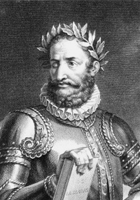

Luís de Camões Biography
Luís Vaz de Camões (Portuguese pronunciation: [luˈiʒ ˈvaʒ dɨ kaˈmõjʃ]; sometimes rendered in English as Camoens or Camoëns (e.g. by Byron in English Bards and Scotch Reviewers), /ˈkæm oʊˌənz/; c. 1524 or 1525 – 20 June [O.S. 10 June] 1580), is considered Portugal's and the Portuguese language's greatest poet. His mastery of verse has been compared to that of Shakespeare, Vondel, Homer, Virgil and Dante. He wrote a considerable amount of lyrical poetry and drama but is best remembered for his epic work Os Lusíadas (The Lusiads). His collection of poetry The Parnasum of Luís de Camões was lost in his lifetime. The influence of his masterpiece Os Lusíadas is so profound that Portuguese is sometimes called the "language of Camões".
Love is a fire that burns unseen,
a wound that aches yet isn't felt,
an always discontent contentment,
...
Waters of gentle Tagus, calmly flowing
Through these green fields ye freshen as ye flow,
On flocks and herds, plants, flowers, all things that grow,
...
Never did love his boldness hurtful find;
Fortune hath ever favours for the bold;
For cowardice, that shivers in the cold,
...
When I behold you, Lady! when my eyes
Dwell on the deep enjoyment of your sight,
I give my spirit to that one delight,
...
Flowers are fresh, and bushes green,
Cheerily the linnets sing;
Winds are soft, and skies serene;
...




Delivering Poems Around The World
Poems are the property of their respective owners. All information has been reproduced here for educational and informational purposes to benefit site visitors, and is provided at no charge...
4/6/2026 2:07:44 PM # 1.0.0