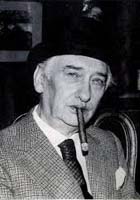

Maurice Gilliams Biography
When Maurice Gilliams (1900-1982) won the Grand Prize for Literature in 1980, many a newspaper journalist was at a loss: as far as the press was concerned Gilliams had always been ‘the Great Unknown’ of Dutch-language literature. But in the literary world itself Gilliams’s work was considered not only an inside tip but also a milestone in the development of the novelist’s art.
In 1936 Gilliams’s Elias of het gevecht met de nachtegalen (Elias or the Struggle with the Nightingales) had ushered in a new, strongly suggestive way of writing and a novelistic structure based on the sonata. The critics called the book a ‘melting pot of genres’: Gilliams’s prose is close to poetry and driven by what he himself called ‘an essayistic motivation’.
Sunday in the country.
Smoking, staring through the window:
linden trees outside,
idle boys are passing by.
...
After the summer it is an old men's land,
here yawns the heath in its vicious gall;
the brown of oaks smells of dogs,
the village glows in its October bells.
...
The stone angel on the Cathedral elevates
his scales at midnight for those who collapse.
The army of lice is cracking. Pissing cats
in draftless winding alleys.
...
I
She carried the lamp behind the water flags.
The midnight dawn gnaws through
the high chamber where Maria sleeps,
...
Avond heeft ons zijn gezag ontplooid.
Zwervers met zwaarmoedige schalmei
dwalen langs de zwoele Scheldeboorden.
Dichters hebben de eerste ster verstaan.
Rode boeren drijven rode stieren.
In de holen langs de haven loeren
stierenogen bloedig in elk mens.
Donkre vrouwen op de wandelbrug
zien drie boten aan de kim verdwijnen,
luistren naar het klotsen van het water,
leunen op de reling zonder spreken.
Maar hun hart, gereed voor machtig wenen,
en hun smachten kunnen zij bedwingen
in een droge, blindversteende blik.
...




Delivering Poems Around The World
Poems are the property of their respective owners. All information has been reproduced here for educational and informational purposes to benefit site visitors, and is provided at no charge...
4/3/2026 4:14:44 AM # 1.0.0