Nida Nawaz
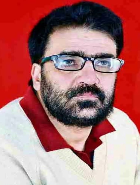

Nida Nawaz Poems
Every word is blood soaked;
Yes every word,
That appears on the black pages of our
disgraced History Book.
...
When they visit us at night,
Never do they knock at our doors,
They just break them open to enter.
Dragging our fathers by their Beards,
...
I ask
The crimson dusk
If blood is the color
That has come to be recognized
...
Should you visit this city of ours?
Then please......
Gouge your eyes
And trample them underneath your feet
...
We will have to break
The deathly silence
That pervades these poor, numbed beings
Herded into deceptive pastures
...
Listen! A handsome visage of this existence
Is surely to gulp down the entire venom on this earth
And grow to be a *NEEL KANTHA.
...
A shadow,
A sudden cry in the dead silence of the night,
Consciousness of some mishap somewhere,
The flickering lamp inside this temple that my heart is,
...
Let me be a pallbearer to his body too,
For I prized him more than my own life.
The irregular rhythm of his heartbeats
Was clearly audible in his smiles.
...
Weep not my darling child,
I too am doing the so called evil deeds
that your father did.
I too shall endure
...
You should move away with
The one whom you love.
Yes move away,
Before this sun rises
...
Vitasta! Be my witness,
Look! The dark Kohl of my eyes,
The red colour of my lips,
Has washed itself with your water.
...
CURFEWED VALENTINE'S DAY
It‘s Valentine‘s day
Whiffs of gentle fragrance
...
Don’t feel scared my little darling
Learn instead
The skill of converting fear
Into a melodious tune
...
(1)
I shall be in quest of you
Till the last post of eternity
Where lies camped
...
(Dedicated to those young children of Kashmir who lost their eyes for ever to the pellets of 'security forces')
It was a fine day
Or so it seemed
...
I never asked the dark black clouds
For any guidance enroute
I never sought to tame
And befriend rabid dogs ever
...
With the chisel of my pains and sorrows
I craft the image of my life
I go on building it thus
Until one day
...
(Addressed to the terrorist)
You challenge the fury
Of your own dark horror
...
Nida Nawaz Biography
Dr. Nida Nawaz: A Voice of Conscience, Dissent, and Cultural Bridges! In the rich and diverse literary landscape of Jammu and Kashmir, Dr. Nida Nawaz occupies a distinctive place as a poet, translator, journalist, broadcaster, and public intellectual whose work transcends linguistic and cultural boundaries. For more than four decades, he has remained an unwavering witness to the aspirations, anxieties, sorrows, and resilience of his people, transforming lived experience into literature marked by emotional depth, social commitment, and artistic refinement. Endowed with a rare combination of scholarly rigor and creative sensibility, Dr. Nawaz holds Master's degrees in Psychology, Hindi, Urdu, and Mass Communication, in addition to a Ph.D. This remarkable academic foundation has enriched his literary vision, enabling him to approach human experience with both intellectual insight and profound empathy. His writings reveal a keen understanding of the human psyche, a deep engagement with society, and an abiding faith in the transformative power of language. As a poet, Dr. Nawaz belongs to that tradition of writers who regard poetry not merely as an artistic exercise but as a moral and emotional response to the realities of their time. His celebrated Hindi poetry collections—'Akshar Akshar Rakt Bhara' (1997) , four'Baraf Aur Aag' (2015) , and 'Andhiare Ki Paziab '(2020) —bear testimony to a poetic consciousness deeply rooted in the struggles and contradictions of contemporary life. His poems traverse the landscapes of pain and hope, alienation and belonging, silence and resistance. They capture the tremors of a troubled age while preserving the enduring human capacity for compassion and renewal. An important dimension of Dr. Nida Nawaz's literary identity is his role as a poetic voice of dissent emerging from the conflict-ridden landscape of Kashmir. Writing in Hindi from a region marked by decades of political turmoil, violence, displacement, and human suffering, he has employed poetry as an instrument of moral witness and human conscience. His poems neither surrender to despair nor seek refuge in rhetoric; rather, they articulate the pain, anxieties, aspirations, and resilience of ordinary people caught in the crosscurrents of history. In contemporary Hindi literature, Dr. Nida Nawaz's poetry stands out as one of the most compelling voices of dissent from Kashmir, distinguished by its ethical urgency, humanistic vision, and unwavering commitment to truth. Through a language that is at once lyrical and incisive, he challenges silence, questions injustice, and affirms the dignity of human life, transforming poetry into a testimony of memory, resistance, and hope. The publication of Samkaal Ki Aawaz (2022) , a selection of his representative poems, further consolidated his position among significant contemporary Hindi poets. The subsequent Punjabi translation, Samkaal Di Aawaz (2023) , expanded the reach of his poetic voice, enabling it to resonate with a wider readership and affirming the universality of the concerns that animate his work. Equally remarkable is Dr. Nawaz's contribution as a translator, a role he has embraced with exceptional dedication and cultural responsibility. Through translation, he has built enduring bridges between languages, regions, and literary traditions. His Hindi translation of Aakh, the acclaimed Kashmiri short-story collection by Mushtaq Ahmad Mushtaq, introduced a wider readership to one of Kashmir's significant literary voices. The work, published by the Jammu and Kashmir Academy of Art, Culture and Languages, stands as an important example of literary mediation across linguistic frontiers. His engagement with translation has extended to some of the most respected literary institutions in the country. He translated Kashmiri poems for the Sahitya Akademi publication Ujla Ragmarag and rendered the Sahitya Akademi Award-winning Hindi poetry collection Anubhav Ke Aakash Par Chand into Kashmiri. His Hindi translation of noted Kashmiri poet Shad Ramzan's Kora Kagaz Sonp Gaya further exemplifies his commitment to preserving and disseminating the literary heritage of Kashmir beyond regional boundaries. Through these works, he has enriched the dialogue between Hindi, Kashmiri, Urdu, Punjabi, and other Indian literary traditions, reinforcing the idea that literature is a shared cultural inheritance. Beyond literature, Dr. Nawaz has made a substantial contribution to journalism and public communication. For nearly thirty-six years, he remained associated with Radio Kashmir Srinagar as the writer of the influential editorial programme Aaj Ki Baat. Through this widely listened-to broadcast, he engaged with contemporary social, cultural, and political issues, helping shape informed public discourse across generations of listeners. His voice, expressed through thoughtful commentary and measured analysis, became an integral part of the region's intellectual life. His journalistic contributions extend to the international sphere as well. As a contributor to the BBC Hindi Service, London, he authored a series of Radio Diaries that offered vivid insights into the everyday realities, cultural nuances, and social transformations of Kashmir. Over the past three decades, he has also written hundreds of feature articles and cover stories for leading Hindi magazines, documenting the region's complexities with rare sensitivity, balance, and human concern. As a chronicler of Kashmir's turbulent contemporary history, he has consistently sought to foreground the human dimension of conflict, giving voice to those who often remain unheard in larger political narratives. A firm believer in the democratization of knowledge, Dr. Nawaz has consistently employed language as a tool of public education and social awareness. During a period spanning nearly ten years, he translated approximately two hundred episodes of science documentaries for Radio Kashmir Srinagar under a project of Vigyan Prasar, Ministry of Science and Technology, Government of India. By making scientific knowledge accessible in local languages, he contributed significantly to the popularization of science among wider audiences. His commitment to public welfare is further reflected in his translation of thirty-five health-awareness booklets of the Ministry of Health and Family Welfare, Government of India, into Urdu, Hindi, and Kashmiri. These translations enabled crucial health information to reach diverse linguistic communities, underscoring his belief that language should serve not only literature but also society at large. The excellence and significance of Dr. Nawaz's literary achievements have been recognized through numerous prestigious honours. His debut poetry collection, Akshar Akshar Rakt Bhara, received the National Award of the Directorate of Hindi, Ministry of Human Resource Development, Government of India, in 1998—an early acknowledgement of a powerful new poetic voice. Over the years, he has also been honoured with the Maithilisharan Gupt Samman, the Yug Kavi Dinanath Nadim Samman, the Dr. Shiv Kumar Mishra Kahani Samman (2016) , and the Ayodhya Prasad Khatri Smriti Samman (2017) , among other accolades that celebrate his multifaceted contribution to literature and culture. Dr. Nida Nawaz's literary journey is, at its core, a journey of dialogue—between languages and cultures, memory and history, individual experience and collective consciousness. Whether writing poetry, translating literary masterpieces, chronicling social realities, or communicating knowledge to the public, he has remained steadfast in his commitment to human values and cultural understanding. In an age increasingly marked by fragmentation, polarization, and erasures of memory, Dr. Nida Nawaz stands as a literary bridge-builder, a chronicler of his times, and a courageous voice of conscience. His oeuvre continues to enrich contemporary Indian literature, preserving the spirit, pain, beauty, and resilience of Kashmir while speaking to universal human concerns that transcend geography, language, and generations. Through his poetry, translations, journalism, and cultural interventions, he has created a body of work that not only documents an era but also illuminates the enduring possibilities of empathy, dialogue, and hope.)
The Best Poem Of Nida Nawaz
Every Word Is Blood Soaked
Every word is blood soaked;
Yes every word,
That appears on the black pages of our
disgraced History Book.
(Translation from Hindi By Autar Mota)
Nida Nawaz Comments




Delivering Poems Around The World
Poems are the property of their respective owners. All information has been reproduced here for educational and informational purposes to benefit site visitors, and is provided at no charge...
8/27/2026 10:32:03 AM # rel_20260826T082754Z_99b456e