Mardin In The Memory Of Stone (Exile And Prayer) Poem by Ekrem KAZAN

Mardin In The Memory Of Stone (Exile And Prayer)

This city, leaning its shoulder against yellow stones,
Mardin waits while gazing at the horizon.
Every evening, as the sun descends
Upon the Mesopotamian plain,
An ancient hymn touches hearts,
The breeze of a centuries-old, unhushed voice
Drifting through the stone streets.

A city where stones speak,
Where doors pray,
Rising toward the sky from stone stairways…

On distant hills,
Standing in the heart of solitude and silence,
Mor Gabriel—
The letters carried by the wind unite in Aramaic,
Still echoing on its walls as far as you can feel…

Once upon a time,
There were children's voices in the courtyards,
'The scent of bread mingling with the sound of bells, '
With morning prayers upon the olive branches…

Then, weary of the years, the roads grew long,
'Lives were squeezed into suitcases, '
The sound of a child's scream caught in the zippers,
Doors were locked,
Keys grew heavy in pockets,
As a people walked toward distant lands;
Those melodies, pulled by hand through stone streets,
Vanished in the rattling wheels of suitcases…

Yet the stones do not forget,
A mother,
In a foreign city,
Sings a lullaby to her child in her tongue once more:
'Moriyo… Moriyo…'
And perhaps that child does not know,
But that lullaby comes from the mountains of Tur Abdin,
From the shadow of ancient monasteries,
For 'exile is distant, but memory is near.'

And one day,
The wind turns back toward Mesopotamia,
Passing through stone streets, finding peace in empty courtyards;
Then you shall hear
The voice waited for with patience from the heart of the city:
'Language does not vanish, faith does not extinguish.'
'The stone endures, time waits.'
And hearts beat with the prayer of an ancient people,
Still rising to the heavens
From its yellow-stoned hills,
'The sacred temple of stones washed by the tears of the sky.'
From Mardin, 'Moriyo… Moriyo…'

Ekrem KAZAN / M. Sc. Architect / 2026
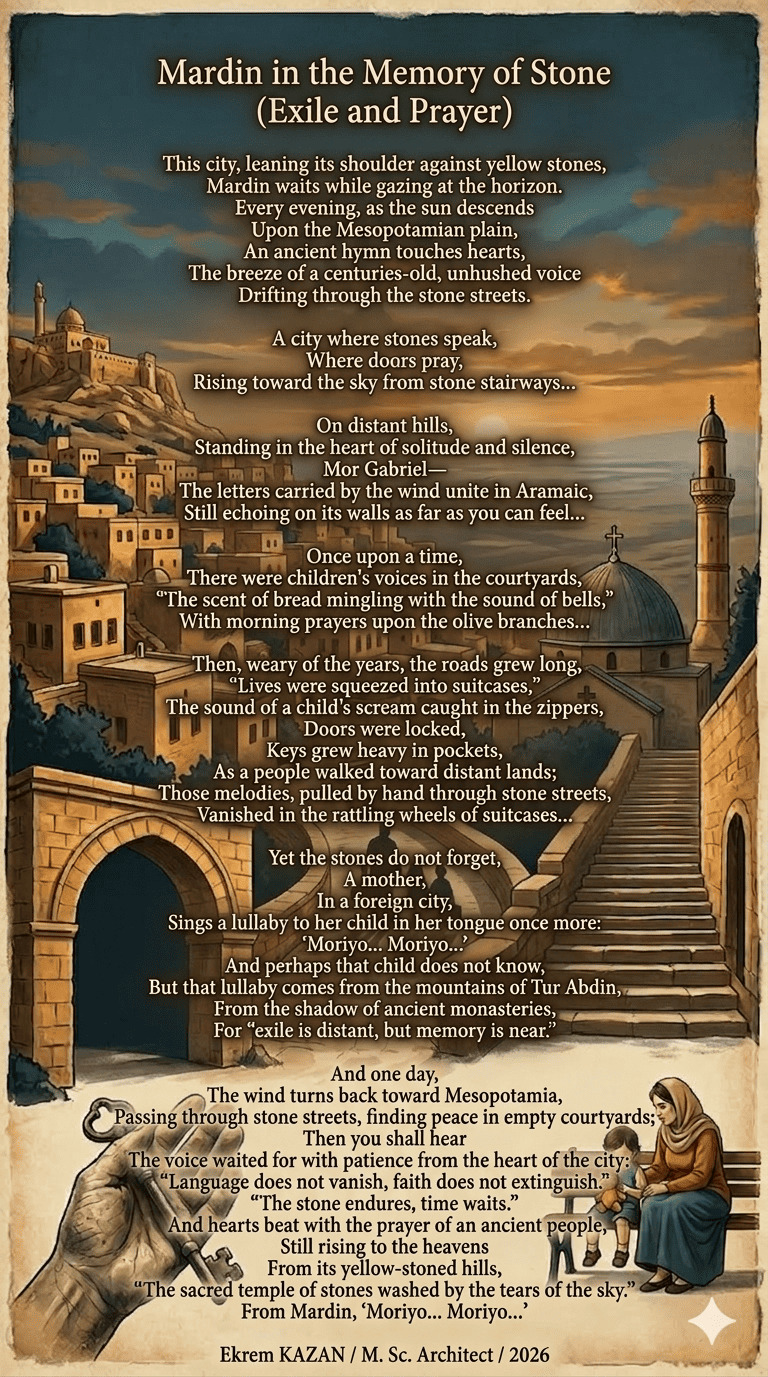
Mardin In The Memory Of Stone
(Exile And Prayer)
POET'S NOTES ABOUT THE POEM
Author's Note In the poem 'Memory of Stone - Exile and Prayer, ' the main theme is treated with clarity and depth, reflecting the condition of an ancient people and the inhabitants of a city—the noble society of Mesopotamia—who for centuries have been forced into displacement by feudal ethnic powers, now etched into the memory of the stone. Migration, exile, and memory are the identity bonds of a people. The city and its stones are presented not merely as physical spaces, but as symbols carrying memory and the past. The memories, culture, and language of a people forced to migrate to various European countries, particularly Sweden, continue to live on within the city and its stones. Although the physical distance created by migration and exile suggests a severance, the bonds are preserved today through memory and prayer. The poem describes the stones and the city as carriers of the past, memories, and prayers through the theme of exile: 'This city, leaning its shoulder against yellow stones...' 'A city where stones speak, where doors pray...' The Mor Gabriel Monastery and the Aramaic inscriptions demonstrate that this ancient culture still breathes. The lines 'The letters carried by the wind unite in Aramaic / Echoing on its walls' emphasize the importance of culture and its heritage. The phrase 'Lives were squeezed into suitcases, ' the locking of doors, and the people migrating to far-off lands highlight the heavy consequences of exile. The impact of the exile of a tens-of-thousands-of-years-old society upon human life is emphasized through this metaphorical imagery. 'Moriyo… Moriyo…' represents the impact of supplication, lament, or longing. It ensures the transmission of culture and language to future generations, embedding the continuity of memory and ancient prayers into the mind from birth through a mother's lullaby. The metaphor 'For exile is distant, but memory is near' strengthens the evidence that the physical distance of migration cannot erase memory or identity. The lines 'Language does not vanish, faith does not extinguish / The stone endures, time waits' convey a message of hope and resistance, asserting that the identity and faith of a people forced into exile endure. In summary: The poem processes the theme of migration and exile through the stones and monasteries of Mardin. It brings to the fore not only pain, but the continuity of memory, prayer, language, and culture. While exile creates a physical rupture, identity and culture—preserved through stones, prayers, and lullabies—have lived from tens of thousands of years ago to the present and will continue to be kept alive in the future. Ekrem KAZAN / M. Sc. Architect / 2026
COMMENTS OF THE POEM
READ THIS POEM IN OTHER LANGUAGES
Close
Error Success