
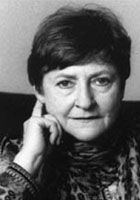

Rosmarie Waldrop Biography
Rosmarie Waldrop (born August 24, 1935), née Sebald, is a contemporary American poet, translator and publisher. Born in Germany, she has lived in the United States since 1958. She has lived in Providence, Rhode Island since the late 1960s. Waldrop is coeditor and publisher of Burning Deck Press, as well as the author or coauthor (as of 2006) of 17 books of poetry, two novels, and three books of criticism.
Early life in Germany
Waldrop was born in Kitzingen am Main on August 24, 1935. Her father, Joseph Sebald, taught physical education at the town's high school. Towards the end of the Second World War, she joined a travelling theatre, but returned to school after in early 1946. At school, she studied piano and flute and played in a youth orchestra. At Christmas 1954, the orchestra gave a concert for American soldiers stationed at Kitzingen. Afterwards, one of the audience, Keith Waldrop invited members of the orchestra to listen to his records. He and Rosmarie became friendly and worked together over the next few months, translating German poetry into English.
Poetry and translations
Rosmarie Waldrop started publishing her own poetry in English in the late 1960s. Since then, she has published over three dozen books of poetry, prose and translation. Today her work is variously characterized as verse experiment, philosophical statement and personal narrative. Of the many formative influences on her mature style, a crucial influence was a year spent in Paris in the early 1970s, where she came into contact with leading avant garde French poets, including Claude Royet-Journoud, Anne-Marie Albiach, and Edmond Jabès. These writers influenced her own work, but equally, she became one of the main translators of their work into English and Burning Deck one of the main vehicles for introducing their work to an English-language readership.
We holler these trysts to be self-exiled that all manatees are credited equi-distant, that they are endured by their Creditor with cervical unanswerable rims. that among these are lightning, lice, and the pushcart of harakiri.
...
Champollion fainted, she says, once he had wrested their secret from the hieroglyphs and saw them turn transparent. The serpent no longer with power to strike, but biting its tail. I smell my salts, my packets of words, panicked.
...
I step into my mother's room, she says, and though a woman's body is a calendar of births and injunctions to death, time disappears. Only dead enough to bury could prove sound to silence or the anxiety I know by heart and lung. In my mother's room.
...
I sit in my own shadow, she says, the way my mother gave birth to it. In artificial light, blinds drawn against the darkness of power. I think of you as if you were that shadow, a natural enclosure, a world, not a slight, so I can wander through your darkness
...
After bitter resistance the river unravels into the night, he says. Washes our daily fare of war out into a dark so deaf, so almost without dimension there is no word to dive from. Body weight displaced by dreams whose own lack promises lucidity so powerful it could shoot a long take to mindlessness.
...




Delivering Poems Around The World
Poems are the property of their respective owners. All information has been reproduced here for educational and informational purposes to benefit site visitors, and is provided at no charge...
4/6/2026 4:57:30 AM # 1.0.0


