Shuntaro Tanikawa
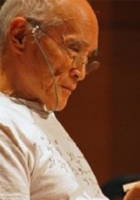

Shuntaro Tanikawa Poems
Mother,
Why is the river laughing?
Why, because the sun is tickling the river
...
Human beings on this small orb
sleep, waken and work, and sometimes
wish for friends on Mars.
...
Sound becoming sound
had begun to infest the blank white paper,
...
'Raindrops on roses and whiskers on kittens,
Bright copper kettles and warm woollem mittens,
Brown paper packages tied up with strings -
...
This thing lying on the desk is now being seen by my eyes. I could
pick it up at this moment. I could cut out a human figure with it. I might
even cut off all my hair. Though it's understood that murder is out of
...
Plump and snug and feathery,
a ball of yarn
rolls gaily down the street
...
As of yesterday I am a squash
and no longer think at all.
I grow gradually fatter
...
Dad's eating, staring striaght ahead,
looking at no one.
My younder brother tells him
...
Bathed by tree filtered sun,
my little girl rides a 'monkey train'
when she comes closer I feel happy
...
The person listening to Mozart curls up like a child,
his eyes following the curled wallpaper as if it were the blue sky,
just as though his invisible sweetheart were whispering in his ear.
...
I grew unwittingly apart
from the world in which I was born
and can no longer walk again
...
何ひとつ書く事はない
私の肉体は陽にさらされている
私の妻は美しい
私の子供たちは健康だ
本当の事を言おうか
詩人のふりはしてるが
私は詩人ではない
私は造られそしてここに放置されている
岩の間にほら太陽があんなに落ちて
海はかえって昏い
この白昼の静寂のほかに
君に告げたい事はない
たとえ君がその国で血を流していようと
ああこの不変の眩しさ!
...
I have nothing to write about
My flesh is bared to the sun
My wife is beautiful
My children are healthy
Let me tell you the truth
I am not a poet
I just pretend to be one
I was created, and left here
Look, the sun cascades among the boulders
making the sea look darker
Other than this quiet at the height of the day
I have nothing I want to tell you about
even if you are bleeding in your country
Ah, this everlasting radiance!
...
この時を永遠にしようとは思わない
この時はこの時で結構だ
私にも刹那をおのがものにするだけの才覚はある
既にいま陽は動いている
というその言葉も
砂の上に書いたにすぎない
それも指でではなく
すぐに不気嫌に変る上気嫌な心で
子供は私に似ている
子供は私に似ていない
どちらも私を喜ばせる
貝殻と小石と壜の破片と
そのように硬くそして脆く
私の心も星の波打際にころがっている
...
I don't want to make this moment eternal
It is fine to own this moment just as it is
Even I have a way to seize a transient moment
The sun is already moving on
These words are merely
written on the sand
not with my fingers
but with my cheerful heart that shifts quickly to gloom
My children look like me
My children don't look like me
Either way it pleases me
Along with sea shells, pebbles and pieces of broken bottles
my heart is left at the water's edge of a planet
just as hard and vulnerable
...
Shuntaro Tanikawa Biography
Shuntarō Tanikawa (谷川 俊太郎 Tanikawa Shuntarō?) (born December 15, 1931 in Tokyo City, Japan) is a Japanese poet and translator. He is one of the most widely read and highly regarded of living Japanese poets, both in Japan and abroad, and a frequent subject of speculations regarding the Nobel Prize in Literature. Several of his collections, including his selected works, have been translated into English, and his Floating the River in Melancholy, translated by William I. Eliott and Kazuo Kawamura, won the American Book Award in 1989. Tanikawa has written more than 60 books of poetry in addition to translating Charles Schulz's Peanuts and the Mother Goose rhymes into Japanese. He was nominated for the 2008 Hans Christian Andersen Award for his contributions to children's literature. He also helped translate Swimmy by Leo Lionni into Japanese. Among his contributions to less conventional art genres is his open video correspondence with Shūji Terayama (Video Letter, 1983). He has collaborated several times with the lyricist Chris Mosdell, including creating a deck of cards created in the omikuji fortune-telling tradition of Shinto shrines, titled The Oracles of Distraction. Tanikawa also co-wrote Kon Ichikawa's Tokyo Olympiad and wrote the lyrics to the theme song of Howl's Moving Castle. Together with Jerome Rothenberg and Hiromi Itō, he has participated in collaborative renshi poetry, pioneered by Makoto Ōoka. The philosopher Tetsuzō Tanikawa was his father.
The Best Poem Of Shuntaro Tanikawa
River
Mother,
Why is the river laughing?
Why, because the sun is tickling the river
Mother,
Why is the river singing?
Because the skylark praised the river's voice
Mother,
Why is the river cold?
It remembers being once loved by the snow.
Mother,
How old is the river?
It's the same age as the forever young
springtime.
Mother,
Why does the river never rest?
Well, you see it's because the mother sea
Is waiting for the river to come home.
Shuntaro Tanikawa Comments




Delivering Poems Around The World
Poems are the property of their respective owners. All information has been reproduced here for educational and informational purposes to benefit site visitors, and is provided at no charge...
10/27/2026 7:27:43 AM # rel_20261026T125300Z_a7741e1