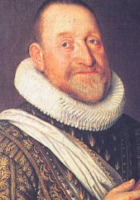

Theodore Agrippa d'Aubigne Biography
Théodore-Agrippa d'Aubigné was a French poet, soldier, propagandist and chronicler. His epic poem Les Tragiques (1616) is widely regarded as his masterpiece.
Born at the Aubigné château of Saint-Maury near Pons in the present day Charente-Maritime, the son of Jean d'Aubigné, who was implicated in the Huguenot Amboise conspiracy to kidnap the King (1560), Aubigné studied in Paris, Orléans, Geneva and Lyon before joining the Huguenot cause of Henry of Navarre (Henry IV) as both soldier and counsellor. Henry's accession to the throne of France entailed an, at least nominal, conversion to the Roman Catholic Church and Aubigné left his service to tend to his own Poitou estates, even though his Huguenot confederates welcomed Henry's religious tolerance. When Marie de' Medici became regent following Henry's assassination in 1610, she embraced the Counter-Reformation and Aubigné's isolation made him an easy target. He was proscribed in 1620 and fled to Geneva where he lived for the rest of his life.
His son Constant d'Aubigné led a scandalous life of adventure. Constant was twice married. His first wife, Ann Marchant, left a son Theodore. His second wife, Jeanne Cardillac, was the mother of Mme. de Maintenon (who, by many interesting turn of life events, married the King of France, Louis XIV) and Chevalier D'Aubigné. The d'Aubigné line was continued through Ann Marchant's son, Theodore (1613-1670). Between his two sons, and then later his three grandsons, the family eventually sailed to England in the late 1680's or America avoiding the Huguenot persecution in Europe. Later in 1715 or thereabouts, most if not all of the main family had sailed to the new world and settled on the east coast near the North River around Falls Church.
His great grand daughter Françoise Charlotte d'Aubigné married into the House of Noailles. From Françoise Charlotte and her husband, Adrien Maurice de Noailles, Agrippa is an ancestor of include the present duc de Noailles, who has three children. Others include Adrienne de Noailles, wife of the infamous marquis de Lafayette; the Duke of Brabant, Archduchess of Austria-Este and Prince Laurent
A l'éclair violent de ta face divine,
N'étant qu'homme mortel, ta céleste beauté
Me fit goûter la mort, la mort et la ruine
...
O mes yeux abusez, esperance perdue,
Et vous, regars transchans qui espiés ces lieux,
Comme je pers mes pleurs, vous perdez vostre veue,
...
Dans l’espais des ombres funebres,
Parmi l’obscure nuit, image de la mort,
Astre de nos esprits, sois l’estoile du Nort,
...
Combatu des vents et des flots,
Voyant tous les jours ma mort preste
Et balayé d’une tempeste
D’ennemis, d’aguetz, de complotz,
...
J'ouvre mon estomac, une tombe sanglante
De maux ensevelis ; pour Dieu, tourne tes yeux,
Diane, et vois au fond mon coeur parti en deux
Et mes poumons gravés d'une ardeur violente,
...




Delivering Poems Around The World
Poems are the property of their respective owners. All information has been reproduced here for educational and informational purposes to benefit site visitors, and is provided at no charge...
3/16/2026 5:14:48 AM # 1.0.0