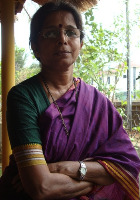

Vaidehi Biography
Janaki Srinivasa Murthy (Kannada: ಜಾನಕಿ ಶ್ರೀನಿವಾಸ ಮೂರ್ತಿ), popularly known by her pen name as Vaidehi (Kannada: ವೈದೇಹಿ) is a well-known writer of modern Kannada language fiction. Vaidehi is one of the most successful woman writer in Kannada and winner of many prestigious national and state level literary awards. She has won the Central Sahitya Akademi Award for her collection of short stories, Krauncha Pakshigalu in 2009.
Early Life
Vaidehi was born on February 12, 1945 to A.V.L Hebbar and Mahalakshmi in Kundapur taluk of Udupi district, Karnataka. She belongs to Kota Brahmin community, a distinct Kannada community mainly found in Kundapur. She grown up in very large family. she lived in a large traditional Brahmin house with many children's, servants, guests and family friends. Her father, A.V.L.Hebbar, is a lawyer and her mother was a second wife of a Hebbar and focal point of the family. Vaidehi speaks a dialect of Kannada, called Kundapur Kannada and uses this dialect in her works. Vaidehi's birth name is Vasanti. the pen-name Vaidehi was given by a Kannada weekly magazine Sudha, she sent a story to Sudha magazine for publishing, but few days later she sent a letter to Sudha weekly magazine editor requesting not to publish the story, as it was a real life story; however, the editor went ahead and published the story by changing her name to Vaidehi, thereafter she become popular and known by name Vaidehi. She did her B.Com (Bachelors of Commerce) in Bhandarkar's college, Kundapur.
Married Life
Vaidehi was married to K. L. Srinivasa Murthy at the age of 23. they have two daughters Nayana Kashyap (née Nayana Murthy) and Pallavi Rao (née Pallavi Murthy). after marriage Vaidehi changed her name to Janaki Srinivasa Murthy and went to Shimoga leaving her native place Kundapur. later they moved to Udupi and then to Manipal. Vaidehi currently lives in Manipal.
Vaidehi daughter Nayana Kashyap is a translator, Kannada writer and English teacher. Nayana has translated many of the Vaidehi's works into English, including five of Vaidehi’s stories. she has translated Vaidehi Kannada novel Jatre into English as A Temple-Fair. A Temple Fair was one of the novel included in Five Novellas by Women which was published by Oxford University Press. Nayana's first collection of poetry in Kannada is Mettila Haadi, she received Attimabbe Pratishtana Award and Kodagina Gowramma Award in 2005 by Kodagu Kannada Sahitya Parishat for her collection of poetry Mettila Haadi. she also tranlsated Pablo Neruda's memoirs as "Nenapu Tereda Kavimana" which has been published by Moulya Prakashana, Karkala. Nayana received M.A and M.Phil degrees and she works as English lecturer in Field Marshal K.M.Cariappa College, Madikeri. she now lives in Madikeri.
Awards
Vaidehi has won numerous awards for her writings in Kannada.
Sahitya Akademi Award in 2009 by Government of India for her collection of story stories Krouncha Pakshigalu
Geetha Desai Datti Nidhi by Karnataka Lekhakiyara Sangha in 1985 for her collection of short stories Antharangada Putagalu and in 1992 for her collection of poems Bindu Bindige
Vardhamana Udayonmukha Award in 1992 by Vardhamana Prashasti Peetha, Mudabidire for her collection of short stories Gola
Katha Award by Katha Organisation, New Delhi in 1992 for her collection of short stories Hagalu Geechida Nenta and in 1997 for her collection of short stories Ammacchiyemba Nenapu
Anupama Award in 1993 for her collection of short stories Samaja Shastrajneya Tippanige
Karnataka State Sahitya Akademi Award in 1993 by Government of Karnataka for her Five children's dramas
Karnataka State Sahitya Akademi Award in 1998 by Government of Karnataka for her collection of essays Mallinathana Dhyana
Sahtya Kama Award for her collections of short stories Ammachi Yemba Nenapu
Sadodita Award in 2001 by Shashwathi Trust
Sudha Weekly's Award for her novel Aprushyaru
Daana Chintamani Attimabbe Award by Government of Karnataka
Attimabbe Award by Attimabbe Pratishtan
There, in the wooden box
my mother's sari, enveloped in white muslin,
with mothballs.
Her sense of order is in each one
of its folds,
and the press of her palm.
A universe of ironing lies beneath the pillow.
Tiny packets of camphor, incense and fragrant roots -
her perfume.
My mother's sari's tucked-in eagerness
coupled with the jingling of bangles
is the zest to get down to work.
Lines running across the broad pallu,
the unbroken bridges of an upright life,
keeping all evil at bay -
a cane to reprove naughty children.
Folds tucked into a knot,
a mysterious treasure-house of meanings,
the pretty yellow Madhura sari
with its green border of blooms . . .
. . . that queen was perhaps like my mother.
Endless is my mother's sari -
the more I wrap it around me, the more it grows.
I remember becoming a midget once
trying to measure it,
trying to drape it.
My mother's sari -
the latex of mango and cashew,
a heaven of Ranja, Kepala and Suragi
golden wheat-beads auguring
the New Year Kani,
the old rolling over each year
to yield a new import.
My mother's sari,
with stars all over its body,
shields those in distress
from rain or shine,
it glows uniquely in the darkness
My mother's sari
of voile or handloom,
with a small dream of silk
When the dream came true,
Father was no more.
She wears it now
but the dream is gone.
There! My mother's old, Udupi weavers' sari
looks at me from where it hangs.
I unfold it and envelop myself in it
uttering with a long sigh
the word ‘Amma' -
a word that remains forever fresh,
however worn with use.
...
Tell me,
you who know of poetry –
I know nothing of it
but I know what rasam is.
...
Having sprinkled some holy water
over the head of the tramp
of the three worlds
Gowri took Shiva to his bath.
...
She said, hunger, thirst.
He said, eat well, drink.
She wept.
He smiled.
The other day he said, window,
not door as she'd imagined.
Wall, he said.
She thought it was space -
was it because all is revealed
when a wall breaks?
She prepared his favourite payasam
What he ate was rayatham.
Why is everything so topsy-turvy?
Was there no air between them,
and so no waves either?
Heads down, words in water
send out a forlorn cry.
It was then that suicide was mentioned.
What did he say?
He found it funny, didn't he?
It happens sometimes.
The sea isn't the sea.
What one assumes to be the shore
is the mere hump of fish-back.
You say something
Another meaning unfolds.
The banter of words, you know.
She: Be honest and tell me,
Which one of us is more insane?
He: What did you say?
Which one wishes to die first?
She: It's hot. Shall I open the window for some air?
He: What? Hunger, thirst?
...
There, in the wooden box
my mother’s sari, enveloped in white muslin,
with mothballs
...




Delivering Poems Around The World
Poems are the property of their respective owners. All information has been reproduced here for educational and informational purposes to benefit site visitors, and is provided at no charge...
4/12/2026 4:27:56 AM # 1.0.0