
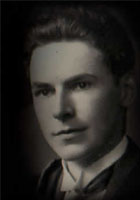

William Soutar Biography
William Soutar was a Scottish poet, born 1898. He served in the navy in World War I, and afterwards studied at the University of Edinburgh, where he encountered the work of Hugh MacDiarmid. This led to a radical alteration in his work, and he became a leading poet of the Scottish Literary Renaissance and 'one of the greatest poets Scotland has produced'. In 1924, he was diagnosed with ankylosing spondylitis. From 1930 he was bedridden. He died of tuberculosis in 1943. His journal, Diary of a Dying Man, was published posthumously and is considered to 'put him into the rank of the great diarists'
One form of verse which he used was the cinquain (now known as American cinquain),these he labelled epigrams. He took up this form in the second half of the 1930s with such enthusiasm that he became an even more prolific practitioner than Adelaide Crapsey had been.
Ayont the Caller Fountain
Whan gowks were in the schaw,
We gether'd the wild roses
That were sae white and sma';
...
End is in beginning;
And in beginning end:
Death is not loss, nor life winning;
But each and to each is friend.
...
They delv'd a saft hole
For Johnnie McNeel:
He aye had been droll
But folk likit him weel.
...
A skelp frae his teacher
For a’ he cudna spell:
A skelp frae his mither
For cowpin owre the kale.
...
O luely, luely, cam she in
And luely she lay doun:
I kent her be her caller lips
And jer breists sae sma' and roun'.
...




Delivering Poems Around The World
Poems are the property of their respective owners. All information has been reproduced here for educational and informational purposes to benefit site visitors, and is provided at no charge...
4/6/2026 7:44:39 PM # 1.0.0


