
Badr Shakir al-Sayyab
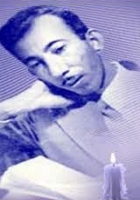

Badr Shakir al-Sayyab Poems
Your eyes are two palm tree forests in early light,
Or two balconies from which the moonlight recedes
When they smile, your eyes, the vines put forth their leaves,
And lights dance . . . like moons in a river
...
I roamed the hills
on the grey horse of a dream
fled the outstretched vistas,
fled the marketplace teeming with vendors,
...
Day has gone.
See. Its wick has died
on a horizon glowing, fireless,
and here you sit, waiting
...
Horses nigh and harbours wait the sunset
Masts reflect rosy sunbeams blood alike!
Lanterns glimmer behind shabby tavern widows
The drink makes him as if an idol
...
Buwaib , Oh Buwaib ,
Bells of a lighthouse lost at the bottom of the sea ,
Water is in the pots , and the sunset in the trees ,
The pots ooze bells of rain ,
...
Praise is to the Lord! However, the plague becomes extended.
Praise to God! However, the pain becomes overwhelmed.
Praise is to God! Some of calamities are a kind of nobility.
Praise is to Lord! Some of catastrophic things are a type of generosity.
...
Please don't go down, the night…
Dead people came along out of the daylight.
Who does return the absent man to his home?
If darkness encamps and there is not great delight.
...
Myths derived the death rattling moments…
Previously were woven by tremble hand…
They were related through dark abysmal period
Two dead men sang its tune…
...
The agent of Qasim open fire upon the spring,
But all the illicit wealth they have amassed
...
The malignant blasts have stung the rosebay.
At once it becomes faded as if the wilted eye
Its ruddiness was shining apparently across the river
The river's waves reflect the rays as if they glimmer
...
The simoom puffs its heat on the midday until late afternoon.
The hot wind blows gustily either lets the sails folded or outspread.
The gulf is overcrowded with toiling seamen.
They rove through the sea to gain their daily bread.
...
Cast out, the darkness, for asylum
O you who guide the ants in the sand
...
Please don't go down, the night…
Dead people came along out of the daylight.
Who does return the absent man to his home?
If darkness encamps and there is not great delight.
...
Through the snow, the sky winnows it to the earth.
Through the dense fog and rain,
I see your eyes sparkling ceaselessly everywhere I go.
Similar to a glimmering star is about to vanish at a daybreak.
...
And even when I smelt your body of stone in my fire
And wrest the ice from your hands, between our eyes
...
The chillness and the hissing sound of fire
And the ashes of the sandy stove.
I sat alone beside the stove abstracted.
The train of my thoughts absorbs the occasion.
...
Badr Shakir al-Sayyab Biography
Badr Shakir al Sayyab (Arabic: بدر شاكر السياب) (December 24, 1926–1964) is an Iraqi and Arab poet, born in Jekor, a town south of Basra in Iraq. The eldest child of a date grower and shepherd.[1] He graduated from the Higher teachers training college of Baghdad in 1948.[2] Badr Shakir was dismissed from his teaching post for being a member of the Iraqi communist party.[3] Badr Shakir al-Sayyab was one of the greatest poets in Arabic literature, whose experiments helped to change the course of modern Arabic poetry. At the end of the 1940s he launched, with Nazik al-Mala'ika,and shortly followed by Abdulwahab albayati and Shathel Taqa, the free verse movement and gave it credibility with the many fine poems he published in the fifties.[4][5] These included the famous "Rain Song," which was instrumental in drawing attention to the use of myth in poetry. He revolutionized all the elements of the poem and wrote highly involved political and social poetry, along with many personal poems. The Palestinian poet Mahmoud Darwish was greatly impressed and influenced by the poetry of Badr Shakir al-Sayyab.[6] The publication of his third volume, Song of Rain, in 1960 was one of the most significant events in contemporary Arabic poetry. He started his career as a Marxist, but reverted to mainstream nationalism without ever becoming fanatical. While still in his thirties, he was struck by a degenerative nervous disorder and died in poverty. He produced seven collections of poetry and several translations, which include the poetry of Louis Aragon, Nazim Hikmet, and Edith Sitwell, who, with T. S. Eliot, had a profound influence on him.[3] Badr went to England for the first time in Autumn of 1962, at a time when his health was deteriorating. He attended Durham University for translation studies.)
The Best Poem Of Badr Shakir al-Sayyab
Rain Song
Your eyes are two palm tree forests in early light,
Or two balconies from which the moonlight recedes
When they smile, your eyes, the vines put forth their leaves,
And lights dance . . . like moons in a river
Rippled by the blade of an oar at break of day;
As if stars were throbbing in the depths of them . . .
And they drown in a mist of sorrow translucent
Like the sea stroked by the hand of nightfall;
The warmth of winter is in it, the shudder of autumn,
And death and birth, darkness and light;
A sobbing flares up to tremble in my soul
And a savage elation embracing the sky,
Frenzy of a child frightened by the moon.
It is as if archways of mist drank the clouds
And drop by drop dissolved in the rain . . .
As if children snickered in the vineyard bowers,
The song of the rain
Rippled the silence of birds in the trees . . .
Drop, drop, the rain
Drip
Dropthe rain
Evening yawned, from low clouds
Heavy tears are streaming still.
It is as if a child before sleep were rambling on
About his mother a year ago he went to wake her, did not find her,
Then was told, for he kept on asking,
'After tomorrow, she'll come back again . . .
That she must come back again,
Yet his playmates whisper that she is there
In the hillside, sleeping her death for ever,
Eating the earth around her, drinking the rain;
As if a forlorn fisherman gathering nets
Cursed the waters and fate
And scattered a song at moonset,
Drip, drop, the rain
Drip, drop, the rain
Do you know what sorrow the rain can inspire?
Do you know how gutters weep when it pours down?
Do you know how lost a solitary person feels in the rain?
Endless, like spilt blood, like hungry people, like love,
Like children, like the dead, endless the rain.
Your two eyes take me wandering with the rain,
Lightning's from across the Gulf sweep the shores of Iraq
With stars and shells,
As if a dawn were about to break from them, But night pulls over them a coverlet of blood. I cry out to the Gulf: 'O Gulf,
Giver of pearls, shells and death!'
And the echo replies,
As if lamenting:
'O Gulf,
Giver of shells and death .
I can almost hear Iraq husbanding the thunder,
Storing lightning in the mountains and plains,
So that if the seal were broken by men
The winds would leave in the valley not a trace of Thamud.
I can almost hear the palmtrees drinking the rain,
Hear the villages moaning and emigrants
With oar and sail fighting the Gulf
Winds of storm and thunder, singing
'Rain . . . rain . . .
Drip, drop, the rain . . .
And there is hunger in Iraq,
The harvest time scatters the grain in-it,
That crows and locusts may gobble their fill,
Granaries and stones grind on and on,
Mills turn in the fields, with them men turning . . .
Drip, drop, the rain . . .
Drip
Drop
When came the night for leaving, how many tears we shed,
We made the rain a pretext, not wishing to be blamed
Drip, drop, the rain
Drip, drop, the rain
Since we had been children, the sky
Would be clouded in wintertime,
And down would pour the rain,
And every year when earth turned green the hunger struck us.
Not a year has passed without hunger in Iraq.
Rain . . .
Drip, drop, the rain . . .
Drip, drop . . .
In every drop of rain
A red or yellow color buds from the seeds of flowers.
Every tear wept by the hungry and naked people
And every spilt drop of slaves' blood
Is a smile aimed at a new dawn,
A nipple turning rosy in an infant's lips
In the young world of tomorrow, bringer of life.
Drip.....
Drop..... the rain . . .In the rain.
Iraq will blossom one day '
I cry out to the Gulf: 'O Gulf,
Giver of pearls, shells and death!'
The echo replies
As if lamenting:
'O Gulf,
Giver of shells and death.'
And across the sands from among its lavish gifts
The Gulf scatters fuming froth and shells
And the skeletons of miserable drowned emigrants
Who drank death forever
From the depths of the Gulf, from the ground of its silence,
And in Iraq a thousand serpents drink the nectar
From a flower the Euphrates has nourished with dew.
I hear the echo
Ringing in the Gulf:
'Rain . . .
Drip, drop, the rain . . .
Drip, drop.'
In every drop of rain
A red or yellow color buds from the seeds of flowers.
Every tear wept by the hungry and naked people
And every spilt drop of slaves' blood
Is a smile aimed at a new dawn,
A nipple turning rosy in an infant's lips
In the young world of tomorrow, bringer of life.
And still the rain pours down.
Translated by: Lena jayyusi and Christopher Middleton
Badr Shakir al-Sayyab Comments
I don't fully understand the meaning of this poem. the crystal melts away with their wailing? what does crystal mean?




Delivering Poems Around The World
Poems are the property of their respective owners. All information has been reproduced here for educational and informational purposes to benefit site visitors, and is provided at no charge...
4/7/2026 9:48:49 AM # 1.0.0



Please advise if there's a translation to English of Tishshar