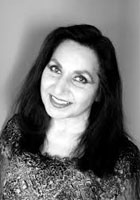

Imtiaz Dharker Biography
Imtiaz Dharker (born 1954 is a Pakistan-born British poet, artist and documentary filmmaker. She has won the Queen’s Gold Medal for her English poetry.
Dharker was born in Lahore, Punjab, Pakistan to Pakistani parents. She was brought up in Glasgow where her family moved when she was less than a year old. She was married to Simon Powell, the founder of the organization Poetry Live, who died in October 2009 after surviving for eleven years with cancer. Dharker divides her time between London, Wales, and Mumbai. She says she describes herself as a "Scottish Muslim Calvinist" adopted by India and married into Wales. Her daughter Ayesha Dharker, (whose father is Anil Dharker), is an actress in international films, television and stage.
Dharker has written five books of poetry Purdah (1989), Postcards from God (1997), I speak for the Devil (2001), The Terrorist at my Table (2006), Leaving Fingerprints (2009) and Over the Moon (2014) (all self-illustrated).
Dharker is a prescribed poet on the British AQA GCSE English syllabus. Her poems Blessing and This Room are included in the AQA Anthology, Different Cultures, Cluster 1 and 2 respectively. Dharker was a member of the judging panel for the 2008 Manchester Poetry Prize, with Carol Ann Duffy and Gillian Clarke. For many she is seen as one of Britain's most inspirational contemporary poets. She was elected a Fellow of the Royal Society of Literature in 2011. In the same year, she was awarded the Cholmondeley Prize by the Society of Authors. In 2011 she judged the Foyle Young Poets of the Year Award with the poet Glyn Maxwell. In 2012 she was nominated a Parnassus Poet at the Festival of the World, hosted by the Southbank Centre as part of the Cultural Olympiad 2012, the largest poetry festival ever staged in the UK, bringing together poets from all the competing Olympic nations. She was the poet in residence at the Cambridge University Library in January–March 2013. In July 2015 she appeared on the popular BBC Radio 4 programme Desert Island Discs and spoke about growing up in Glasgow and her decision to leave her family and elope to India, as well as her second marriage to the late Simon Powell.
When I can't comprehend
why they're burning books
or slashing paintings,
...
Paper that lets the light
shine through, this
is what could alter things.
Paper thinned by age or touching,
the kind you find in well-used books,
the back of the Koran, where a hand
has written in the names and histories,
who was born to whom,
the height and weight, who
died where and how, on which sepia date,
pages smoothed and stroked and turned
transparent with attention.
If buildings were paper, I might
feel their drift, see how easily
they fall away on a sigh, a shift
in the direction of the wind.
Maps too. The sun shines through
their borderlines, the marks
that rivers make, roads,
railtracks, mountainfolds,
Fine slips from grocery shops
that say how much was sold
and what was paid by credit card
might fly our lives like paper kites.
An architect could use all this,
place layer over layer, luminous
script over numbers over line,
and never wish to build again with brick
or block, but let the daylight break
through capitals and monoliths,
through the shapes that pride can make,
find a way to trace a grand design
with living tissue, raise a structure
never meant to last,
of paper smoothed and stroked
and thinned to be transparent,
turned into your skin.
...
The place is full of worshippers.
You can tell by the sandals
piled outside, the owners' prints
worn into leather, rubber, plastic,
a picture clearer than their faces
put together, with some originality,
brows and eyes, the slant
of cheek to chin.
What prayer are they whispering?
Each one has left a mark,
the perfect pattern of a need,
sole and heel and toe
in dark, curved patches,
heels worn down,
thongs ragged, mended many times.
So many shuffling hopes,
pounded into print,
as clear as the pages of holy books,
illuminated with the glint
of gold around the lettering.
What are they whispering?
Outside, in the sun,
such a quiet crowd
of shoes, thrown together
like a thousand prayers
washing against the walls of God.
...
The school-bell is a call to battle,
every step to class, a step into the firing-line.
Here is the target, fine skin at the temple,
cheek still rounded from being fifteen.
Surrendered, surrounded, she
takes the bullet in the head
and walks on. The missile cuts
a pathway in her mind, to an orchard
in full bloom, a field humming under the sun,
its lap open and full of poppies.
This girl has won
the right to be ordinary,
wear bangles to a wedding, paint her fingernails,
go to school. Bullet, she says, you are stupid.
You have failed. You cannot kill a book
or the buzzing in it.
A murmur, a swarm. Behind her, one by one,
the schoolgirls are standing up
to take their places on the front line.
...
Purdah I
One day they said she was old enough to learn some shame.
She found it came quite naturally.
Purdah is a kind of safety.
The body finds a place to hide.
The cloth fans out against the skin
much like the earth falls
on coffins after they put the dead men in.
People she has known
stand up, sit down as they have always done.
But they make different angles
in the light, their eyes aslant,
a little sly.
She half-remembers things
from someone else's life,
Perhaps from yours, or mine -
carefully carrying what we do not own:
between the thighs, a sense of sin.
We sit still, letting the cloth grow
a little closer to our skin.
A light filters inward
through our bodies' walls.
Voices speak inside us,
echoing in the spaces we have just left.
She stands outside herself,
sometimes in all four corners of a room.
Wherever she goes, she is always
inching past herself,
as if she were a clod of earth
and the roots as well,
scratching for a hold
between the first and second rib.
Passing constantly out of her own hands
into the corner of someone else's eyes…
while doors keep opening
inward and again
inward.
Purdah II
The call breaks its back
across the tenements: ‘Allah-u-Akbar'.
Your mind throws black shadows
on marble cooled by centuries of dead.
A familiar script racks the walls.
The pages of the Koran
turn, smooth as old bones
in your prodigal hands.
In the tin box of your memory
a coin of comfort rattles
against the strangeness of a foreign land.
* * *
Years of sun were concentrated
into Maulvi's fat dark finger
hustling across the page,
nudging words into your head;
words unsoiled by sense,
pure rhythm on the tongue.
The body, rocked in time
with twenty others, was lulled
into thinking it had found a home.
* * *
The new Hajji, just fifteen,
had cheeks quite pink with knowledge
and eyes a startling blue.
He snapped a flower off his garland
and looked to you.
There was nothing holy in his look.
Hands that had prayed at Mecca
dropped a sly flower on your book.
You had been chosen.
Your dreams were full of him for days.
Making pilgrimages to his cheeks,
You were scorched,
long before the judgement,
by the blaze.
Your breasts, still tiny, grew an inch.
The cracked voice calls again.
A change of place and time.
Much of the colour drains away.
The brightest shades are in your dreams,
A picture-book, a strip of film.
The rest forget to sing.
Evelyn, the medium from Brighton,
said, ‘I see you quite different in my head,
not dressed in this cold blue.
I see your mother bringing you
a stretch of brilliant fabric, red.
Yes, crimson red, patterned through
with golden thread.'
There she goes, your mother,
still plotting at your wedding
long after she is dead.
* * *
They have all been sold and bought,
the girls I knew,
unwilling virgins who had been taught,
especially in this strangers' land, to bind
their brightness tightly round,
whatever they might wear,
in the purdah of the mind.
They veiled their eyes
with heavy lids.
They hid their breasts,
but not the fullness of their lips.
* * *
The men you knew
were in your history, striding proud
with heavy feet across a fertile land.
A horde of dead men
held up your head,
above the mean temptations
of those alien hands.
You answered to your race.
Night after virtuous night
you performed for them.
They warmed your bed.
* * *
A coin of comfort in the mosque
clatters down the years of loss
* * *
You never met those men
with burnt-out eyes, blood
dripping from their beards.
You remember the sun
pouring out of Maulvi's hands.
It was to save the child
the lamb was sacrificed;
to save the man,
the scourge and stones. God was justice.
Justice could be dread.
But woman. Woman,
you have learnt
that when God comes
you hide your head.
* * *
There are so many of me.
I have met them, meet them every day,
recognise their shadows on the streets.
I know their past and future
in cautious way they place their feet.
I can see behind their veils,
and before they speak
I know their tongues, thick
with the burr of Birmingham
or Leeds.
* * *
Break cover.
Break cover and let the girls with tell-tale lips.
We'll blindfold the spies. Tell me
what you did when the new moon
sliced you out of purdah,
your body shimmering through the lies.
* * *
Saleema of the swan neck
and tragic eyes, knew from films
that the heroine was always pure,
untouched; nevertheless
poured out her breasts to fill the cup
of his white hands
(the mad old artist with the pigeon chest)
and marveled at her own strange wickedness.
* * *
Bought and sold, and worse,
grown old. She married back home,
as good girls do,
in a flurry of red the cousin -
hers or mine, I cannot know -
had annual babies, then rebelled at last.
At last a sign, behind the veil,
of life;
found another man, became another wife,
and sank into the mould
of her mother's flesh
and mind, begging approval from the rest.
Her neck is bowed as if she wears a hood.
Eyes still tragic, when you meet her
on the high street,
and watchful as any creature
that lifts its head and sniffs the air
only to scent its own small trail of blood.
* * *
Naseem, you ran away
and your mother burned with shame.
Whatever we did,
the trail was the same:
the tear-stained mother, the gossip aunts
looking for shoots to smother
inside all our cracks.
The table is laden
and you are remembered
among the dead. No going back.
The prayer's said.
And there you are with your English boy
who was going to set you free,
trying to smile and be accepted,
always on your knees.
* * *
There you are, I can see you all now
in the tenements up north.
In or out of purdah. Tied, or bound.
Shaking your box to hear
how freedom rattles…
one coin, one sound.
...




Delivering Poems Around The World
Poems are the property of their respective owners. All information has been reproduced here for educational and informational purposes to benefit site visitors, and is provided at no charge...
4/4/2026 1:11:32 AM # 1.0.0