Sinter's Cross Poem by David Welch
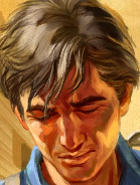

Sinter's Cross
You see that there? That's Sinter's Cross,
on the bluff by the stream,
a cross has stood there with his name
since eighteen eighty-three.
That was the year John Sinter fell,
but I'll not skip ahead,
I'll do it right and tell the tale
of how the man got dead.
Sinter was a farm boy, like most,
from Ohio he came,
the sixth of seven, he'd be passed
on no land in his name.
Not that his parents' farm was worth
much money anyway,
it was clear, to improve his lot,
he'd have to move away.
But folks said that the vast frontier
was now disappearing,
that what was left was just desert,
not for fit for sheep-rearing!
The companies still selling land
did tell him much the same,
but Sinter poured through the listings,
his efforts weren't in vain.
He found a plot that just might work,
north Arizona land,
seemed to have enough streams and trees
to support a farmstand.
It was close to some tall mountains,
was not an easy till,
but he had a wife to support,
and men survive on will.
He bought two railroad tickets and
started out on his way,
hired a packhorse for his goods,
had to walk to the place.
'Twas a stretch of mountain meadow,
beneath San Francisco peaks,
set up their tent and John set off,
fresh timber did he seek.
He set to building a cabin,
summer sun on his back,
and to a nearby stream his wife
manage to clear his track.
It wouldn't be an easy life,
but they were still content,
five hundred acres to grow crops,
their lives now up to them.
What neither of them would know then
was high up on the slopes
six renegade Apache camped,
from the Res they had flown.
Like Geronimo they would fight,
they pledged to die with arms,
to take back all the land they'd lost,
they meant to do folks harm.
And when they rode up to their tend
they didn't try to hide,
John felt relief that his dear wife
was off by the Creekside.
They rode up with annoyed faces,
stared daggers down at him,
John has a pistol in his hand,
but still his fate looked grim.
The mounted men were all well-armed,
with rifle and knife-blade,
he might get one, but knew he'd not
get the best of the trade.
One barked loud in his own language,
them lifted up his gun,
they made hand motions to make clear
they wanted him to run.
At first he turned, as if to go,
then dashed behind the tent,
the chest inside could block bullets,
John fired straight for them.
A warrior shrieked, pitched sideways,
bled when he hit the ground,
the Apache spurred their horses,
looking to flank around.
But John expected such a thig,
he looked right and saw one,
the Indian jerked violently,
bullet through his eardrum.
Just them a blast slammed into John,
a round shot from behind,
he rolled to see a man on foot,
swung his pistol inline.
At the same moment they fired,
John's shot caught the man's head,
the Indian's broke Sinter's ribs,
his vest covered in red.
The leader of the band stalked up,
face a mask of hot rage,
John lay there, seeing death draw close,
half-paralyzed with pain.
The man took out a tomahawk,
swing it hard at John's skull,
Sinter jerked his head to the side
and felt the impact dulled.
His head was grazed, the skin was gone,
but he was still alive,
with fading strength he drew his knife
and plunged it in the man's thigh.
A red plume poured out from the wound,
he'd slashed the artery,
the last two let loose with their guns,
Jake met eternity.
Now this all may sound impressive,
a defiant last stand,
not something you might expect from
an untrained farming man,
but John did not go down fighting
for anything like that,
John rushed in and went down swinging
in order to distract,
to buy his wife some time to hide,
for she was with child,
to save the both from being slain,
or something more vile.
She ran and hid beneath that bluff,
where it juts, overhangs,
popping up jus to take quick breaths
as her foes search the land.
But having lost so many friends,
the last two stayed not long,
and she emerged to destruction,
seeing what had gone on.
She found the camp torn up, of course,
she found her husband's corpse,
and in tears dragged him from the camp
to the bluff on the shore.
With no real strength to dig a grave
she piled river rocks,
with two sticks she managed to make
a rude but steady cross.
She carved his last name with a knife,
quite crude, but plain to see,
then finally set out upon
her own trying journey.
Eleven miles, all on foot,
to reach the nearest ranch,
when the cowhands saw her rough state
even the men did blanch.
Riders went out to fetch the troops,
posses were also formed,
it wasn't but a week until
those rocky peaks were stormed.
Within three days the two were found,
in a lopsided fight
they were cut down and sent to join
John in that final night.
Since that day there has been a cross
perched high atop the bluff,
and when the town grew up they thought
they should show him their love.
That's how we became Sintertown,
their way to show respect,
when the first cross rotted away
the quickly built the next.
The one you see now was installed
back in nineteen-thirty,
and it's still standing proudly since
they made it of concrete.
It may be trendy in our times
to mock the settlers brave,
to feel bad for the Indians,
and yes, mistakes were made.
Some might not even like this tale,
but we still tell it yet,
since even now I can't recall
a more heroic death.
This poem has not been translated into any other language yet.
I would like to translate this poem



Delivering Poems Around The World
Poems are the property of their respective owners. All information has been reproduced here for educational and informational purposes to benefit site visitors, and is provided at no charge...
8/28/2026 10:16:45 PM # rel_20260827T145718Z_a0f1bd3