
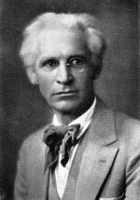

William Ellery Leonard Biography
William Ellery Leonard (January 25, 1876, in Plainfield, New Jersey – May 22, 1944, in Madison, Wisconsin) was an American poet and literary scholar.
From 1906 until the end of his life, Leonard taught at the University of Wisconsin–Madison, being an assistant professor of English. Among his prominent students were literary critic Leslie Fiedler and poet Clara Leiser, the latter an outspoken opponent of Nazism.
Over his career Leonard wrote numerous volumes of poetry, the first of which was Sonnets and Poems, a collection regarded as showing emotional intensity as well as psychological depth. He is most remembered, however, for Two Lives, a cycle of 250 sonnets telling the story of his tragic marriage. Stephen Vincent Benét called it the best American poem of the twentieth century. In his psychological autobiography, The Locomotive-God, he probed his agoraphobia. Leonard is also known for his many scholarly works, particularly translations of Aesop and Lucretius as well as the epic Beowulf.
(After completing a book for one now dead)
(O Earth-and-Autumn of the Setting Sun,
She is not by, to know my task is done.)
...
HOW came I that loved stars, moon, and flame,
And unimaginable wind and sea,
All inner shrines and temples of the free,
...
Man's mind is larger than his brow of tears;
This hour is not my all of time; this place
My all of earth; nor this obscene disgrace
...
Blue are the twilight heavens above the hill,
A yellow half-moon's high within the blue,
And rosy May-night clouds are soft and still,
...
I know the sorrows of the last abyss:
I walked the cold black pools without a star;
I lay on rock of unseen flint and spar;
I heard the execrable serpent hiss;
...




Delivering Poems Around The World
Poems are the property of their respective owners. All information has been reproduced here for educational and informational purposes to benefit site visitors, and is provided at no charge...
3/15/2026 5:30:52 AM # 1.0.0


