
Fernando Pessoa
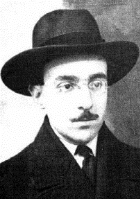

Fernando Pessoa Poems
Symbols? I'm sick of symbols...
Some people tell me that everything is symbols.
They're telling me nothing.
What symbols? Dreams...
Let the sun be a symbol, fine...
Let the moon be a symbol, fine...
Let the earth be a symbol, fine...
But who notices the sun except when the rain stops
And it breaks through the clouds and points behind its back
To the blue of the sky?
And who notices the moon except to admire
Not it but the beautiful light it radiates?
And who notices the very earth we tread?
We say earth and think of fields, trees and hills,
Unwittingly diminishing it,
For the sea is also earth.
Okay, let all of this be symbols.
But what's the symbol - not the sun, not the moon, not the earth -
In this premature sunset amidst the fading blue
With the sun caught in expiring tatters of clouds
And the moon already mystically present at the other end of the sky
As the last remnant of daylight
Gilds the head of the seamstress who hesitates at the corner
Where she used to linger (she lives nearby) with the boyfriend who left her?
Symbols? I don't want symbols.
All I want - poor frail and forlorn creature! -
Is for the boyfriend to go back to the seamstress.
...
I know, I alone
How much it hurts, this heart
With no faith nor law
...
I am tired, that is clear,
Because, at certain stage, people have to be tired.
Of what I am tired, I don't know:
...
Since we do nothing in this confused world
That lasts or that, lasting, is of any worth,
And even what's useful for us we lose
So soon, with our own lives,
Let us prefer the pleasure of the moment
To an absurd concern with the future,
Whose only certainty is the harm we suffer now
To pay for its prosperity.
Tomorrow doesn't exist. This moment
Alone is mine, and I am only who
Exists in this instant, which might be the last
Of the self I pretend to be.
...
Good. I have done. My heart weighs. I am sad.
The outer day, void statue of lit blue,
...
My soul is a stiff pageant, man by man,
Of some Egyptian art than Egypt older,
Found in some tomb whose rite no guess can scan,
...
My weary life, that lives unsatisfied
On the foiled off-brink of being e'er but this,
To whom the power to will hath been denied
And the will to renounce doth also miss;
...
We are in Fate and Fate's and do but lack
Outness from soul to know ourselves its dwelling,
And do but compel Fate aside or back
...
When I have sense of what to sense appears,
Sense is sense ere 'tis mine or mine in me is.
When I hear, Hearing, ere I do hear, hears.
...
He that goes back does, since he goes, advance,
Though he doth not advance who goeth back,
And he that seeks, though he on nothing chance,
May still by words be said to find a lack.
...
Happy the maimed, the halt, the mad, the blind-
All who, stamped separate by curtailing birth,
Owe no duty's allegiance to mankind
...
The edge of the green wave whitely doth hiss
Upon the wetted sand. I look, yet dream.
Surely reality cannot be this!
...
O meu olhar é nítido como um girassol.
Tenho o costume de andar pelas estradas
Olhando para a direita e para a esquerda,
E de vez em quando olhando para trás…
E o que vejo a cada momento
É aquilo que nunca antes eu tinha visto,
E eu sei dar por isso muito bem…
Sei ter o pasmo comigo
Que tem uma criança se, ao nascer,
Reparasse que nascera deveras…
Sinto-me nascido a cada momento
Para a eterna novidade do mundo…
Creio no mundo como num malmequer,
Porque o vejo. Mas não penso nele
Porque pensar é não compreender…
O mundo não se fez para pensarmos nele
(Pensar é estar doente dos olhos)
Mas para olharmos para ele e estarmos de acordo.
Eu não tenho filosofia: tenho sentidos…
Se falo na Natureza não é porque saiba o que ela é,
Mas porque a amo, e amo-a por isso,
Porque quem ama nunca sabe o que ama
Nem sabe porque ama, nem o que é amar…
Amar é a eterna inocência,
E a única inocência é não pensar…
...
My gaze is clear like a sunflower.
It is my custom to walk the roads
Looking right and left
And sometimes looking behind me,
And what I see at each moment
Is what I never saw before,
And I'm very good at noticing things.
I'm capable of feeling the same wonder
A newborn child would feel
If he noticed that he'd really and truly been born.
I feel at each moment that I've just been born
Into a completely new world…
I believe in the world as in a daisy,
Because I see it. But I don't think about it,
Because to think is to not understand.
The world wasn't made for us to think about it
(To think is to have eyes that aren't well)
But to look at it and to be in agreement.
I have no philosophy, I have senses…
If I speak of Nature it's not because I know what it is
But because I love it, and for that very reason,
Because those who love never know what they love
Or why they love, or what love is.
To love is eternal innocence,
And the only innocence is not to think…
...
Pensar em Deus é desobedecer a Deus,
Porque Deus quis que o não conhecêssemos,
Por isso se nos não mostrou…
Sejamos simples e calmos,
Como os regatos e as árvores,
E Deus amar-nos-á fazendo de nós
Nós como as árvores são árvores
E como os regatos são regatos,
E dar-nos-á verdor na sua primavera,
E um rio aonde ir ter quando acabemos…
E não nos dará mais nada, porque dar-nos mais seria tirar-nos-nos.
...
To think about God is to disobey God,
Since God wanted us not to know him,
Which is why he didn't reveal himself to us…
Let's be simple and calm,
Like the trees and streams,
And God will love us, making us
Us even as the trees are trees
And the streams are streams,
And will give us greenness in the spring, which is its season,
And a river to go to when we end…
And he'll give us nothing more, since to give us more would make us less us.
...
O mistério das cousas, onde está ele?
Onde está ele que não aparece
Pelo menos a mostrar-nos que é mistério?
Que sabe o rio disso e que sabe a árvore?
E eu, que não sou mais do que eles, que sei disso?
Sempre que olho para as cousas e penso no que os homens
pensam delas,
Rio como um regato que soa fresco numa pedra.
Porque o único sentido oculto das cousas
É elas não terem sentido oculto nenhum.
É mais estranho do que todas as estranhezas
E do que os sonhos de todos os poetas
E os pensamentos de todos os filósofos,
Que as cousas sejam realmente o que parecem ser
E não haja nada que compreender.
Sim, eis o que os meus sentidos aprenderam sozinhos: -
As cousas não têm significação: têm existência.
As cousas são o único sentido oculto das cousas.
...
The mystery of things - where is it?
Why doesn't it come out
To show us at least that it's mystery?
What do the river and the tree know about it?
And what do I, who am no more than they, know about it?
Whenever I look at things and think about what people think of them,
I laugh like a brook cleanly plashing against a rock.
For the only hidden meaning of things
Is that they have no hidden meaning.
It's the strangest thing of all,
Stranger than all poets' dreams
And all philosophers' thoughts,
That things are really what they seem to be
And there's nothing to understand.
Yes, this is what my senses learned on their own:
Things have no meaning: they exist.
Things are the only hidden meaning of things.
...
Num dia excessivamente nítido,
Dia em que dava a vontade de ter trabalhado muito
Para nele não trabalhar nada,
Entrevi, como uma estrada por entre as árvores,
O que talvez seja o Grande Segredo,
Aquele Grande Mistério de que os poetas falsos falam.
Vi que não há Natureza,
Que Natureza não existe,
Que há montes, vales, planícies,
Que há árvores, flores, ervas,
Que há rios e pedras,
Mas que não há um todo a que isso pertença,
Que um conjunto real e verdadeiro
É uma doença das nossas ideias.
A Natureza é partes sem um todo.
Isto é talvez o tal mistério de que falam.
Foi isto o que sem pensar nem parar,
Acertei que devia ser a verdade
Que todos andam a achar e que não acham,
E que só eu, porque a não fui achar, achei.
...
On an incredibly clear day,
The kind when you wish you'd done lots of work
So that you wouldn't have to work that day,
I saw - as if spotting a road through the trees -
What may well be the Great Secret,
That Great Mystery the false poets speak of.
I saw that there is no Nature,
That Nature doesn't exist,
That there are hills, valleys and plains,
That there are trees, flowers and grass,
That there are rivers and stones,
But that there is no whole to which all this belongs,
That a true and real ensemble
Is a disease of our own ideas.
Nature is parts without a whole.
This is perhaps the mystery they speak of.
This is what, without thinking or pausing,
I realized must be the truth
That everyone tries to find but doesn't find
And that I alone found, because I didn't try to find it.
...
Fernando Pessoa Biography
Fernando Pessoa, born Fernando António Nogueira Pessôa (/pɛˈsoʊə/; Portuguese: [fɨɾˈnɐ̃dw ɐ̃ˈtɔɲju nuˈɣejɾɐ pɨˈsow.wɐ]; June 13, 1888 – November 30, 1935), was a Portuguese poet, writer, literary critic, translator, publisher and philosopher, described as one of the most significant literary figures of the 20th century and one of the greatest poets in the Portuguese language. He also wrote in and translated from English and French. Pessoa was a prolific writer, and not only under his own name, for he dreamed up approximately seventy-five others. He did not call them pseudonyms because he felt that did not capture their true independent intellectual life and instead called them heteronyms. These imaginary figures sometimes held unpopular or extreme views.)
The Best Poem Of Fernando Pessoa
Symbols? I'm sick of symbols...
Symbols? I'm sick of symbols...
Some people tell me that everything is symbols.
They're telling me nothing.
What symbols? Dreams...
Let the sun be a symbol, fine...
Let the moon be a symbol, fine...
Let the earth be a symbol, fine...
But who notices the sun except when the rain stops
And it breaks through the clouds and points behind its back
To the blue of the sky?
And who notices the moon except to admire
Not it but the beautiful light it radiates?
And who notices the very earth we tread?
We say earth and think of fields, trees and hills,
Unwittingly diminishing it,
For the sea is also earth.
Okay, let all of this be symbols.
But what's the symbol - not the sun, not the moon, not the earth -
In this premature sunset amidst the fading blue
With the sun caught in expiring tatters of clouds
And the moon already mystically present at the other end of the sky
As the last remnant of daylight
Gilds the head of the seamstress who hesitates at the corner
Where she used to linger (she lives nearby) with the boyfriend who left her?
Symbols? I don't want symbols.
All I want - poor frail and forlorn creature! -
Is for the boyfriend to go back to the seamstress.
Fernando Pessoa Comments
By 1914 Pessoa had started publishing criticism in prose and poetry. This year is also marked as the birth year of Pessoa’s three main literary personas which he preferred to call heteronyms rather than pseudonyms. These were Alberto Caeiro, Ricardo Reis and Alvaro de Campos. Although throughout his career Pessoa used at least Seventy Eight of his literary figures yet these were the three main heteronyms he returned to from time to time. They all were unique in every manner; they had their own writing style, history, exclusive personality and distinctive physiology. In 1935 Pessoa wrote a letter Adolfo Casais Monteiro explaining how he writes through the names of his three favorite heteronyms.
“How do I write in the name of these three? Caeiro, through sheer and unexpected inspiration, without knowing or even suspecting that I’m going to write in his name. Ricardo Reis, after an abstract meditation, which suddenly takes concrete shape in an ode. Campos, when I feel a sudden impulse to write and don’t know what.” Pessoa is known and praised to have given his heteronyms a full life, entirely different and separate from his own, compared to many other literary personas adopted by noble writers of his era.




Delivering Poems Around The World
Poems are the property of their respective owners. All information has been reproduced here for educational and informational purposes to benefit site visitors, and is provided at no charge...
7/7/2026 4:12:07 PM # 1.0.0


Today I began reading Pessoa's The Book of Disquiet. Any comments appreciated. Pessoa's poetry resonates feelings.