
Jane Hirshfield
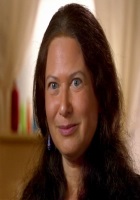

Jane Hirshfield Poems
I was walking again
in the woods,
a yellow light
was sifting all I saw.
...
Some stories last many centuries,
others only a moment.
All alter over that lifetime like beach-glass,
grow distant and more beautiful with salt.
...
You work with what you are given,
the red clay of grief,
the black clay of stubbornness going on after.
Clay that tastes of care or carelessness,
clay that smells of the bottoms of rivers or dust.
...
In Sung China,
two monks friends for sixty years
watched the geese pass.
Where are they going?
...
It is a simple garment, this slipped-on world.
We wake into it daily - open eyes, braid hair -
a robe unfurled
in rose-silk flowering, then laid bare
...
The heart's reasons
seen clearly,
even the hardest
will carry
its whip-marks and sadness
and must be forgiven.
...
One day in that room, a small rat.
Two days later, a snake.
Who, seeing me enter,
whipped the long stripe of his
body under the bed,
then curled like a docile house-pet.
...
As the house of a person
in age sometimes grows cluttered
with what is
too loved or too heavy to part with,
...
Today when persimmons ripen
Today when fox-kits come out of their den into snow
Today when the spotted egg releases its wren song
...
A hand is not four fingers and a thumb.
Nor is it palm and knuckles,
not ligaments or the fat's yellow pillow,
not tendons, star of the wristbone, meander of veins.
...
My mare, when she was in heat,
would travel the fenceline for hours,
wearing the impatience
in her feet into the ground.
...
The heat of autumn
is different from the heat of summer.
One ripens apples, the other turns them to cider.
One is a dock you walk out on,
...
An hour is not a house,
a life is not a house,
you do not go through them as if
they were doors to another.
Yet an hour can have shape and proportion,
four walls, a ceiling.
An hour can be dropped like a glass.
Some want quiet as others want bread.
Some want sleep.
My eyes went
to the window, as a cat or dog left alone does.
...
I moved my chair into sun
I sat in the sun
the way hunger is moved when called fasting.
...
Like the small hole by the path-side something lives in,
in me are lives I do not know the names of,
nor the fates of,
nor the hungers of or what they eat.
They eat of me.
Of small and blemished apples in low fields of me
whose rocky streams and droughts I do not drink.
And in my streets—the narrow ones,
unlabeled on the self-map—
they follow stairs down music ears can't follow,
and in my tongue borrowed by darkness,
in hours uncounted by the self-clock,
they speak in restless syllables of other losses, other loves.
There too have been the hard extinctions,
missing birds once feasted on and feasting.
There too must be machines
like loud ideas with tungsten bits that grind the day.
A few escape. A mercy.
They leave behind
small holes that something unweighed by the self-scale lives in.
...
Lie down, you are horizontal.
Stand up, you are not.
I wanted my fate to be human.
Like a perfume
that does not choose the direction it travels,
that cannot be straight or crooked, kept out or kept.
Yes, No, Or
—a day, a life, slips through them,
taking off the third skin,
taking off the fourth.
And the logic of shoes becomes at last simple,
an animal question, scuffing.
Old shoes, old roads—
the questions keep being new ones.
Like two negative numbers multiplied by rain
into oranges and olives.
...
even
a small purple artichoke
boiled
in its own bittered
and darkening
waters
grows tender,
grows tender and sweet
patience, I think,
my species
keep testing the spiny leaves
the spiny heart
...
Wakeful, sleepy, hungry, anxious,
restless, stunned, relieved.
Does a tree also?
A mountain?
A cup holds
sugar, flour, three large rabbit-breaths of air.
I hold these.
...
Jane Hirshfield Biography
Jane Hirshfield (born 24 February 1953)[1] is an American poet, essayist, and translator. She was born in February 24, 1953. She was born on East 20th Street, New York City. She received her bachelor's degree from Princeton University in the school's first graduating class to include women. Hirshfield's seven books of poetry have each received numerous awards. Her fifth book, Given Sugar, Given Salt, was a finalist for the National Book Critics Circle Award and her sixth collection, After, was shortlisted for the T.S. Eliot Prize (UK) and named a 'best book of 2006' by The Washington Post, The San Francisco Chronicle, and the Financial Times. She has written a book of essays, Nine Gates: Entering the Mind of Poetry. The Ink Dark Moon, her co-translation of the work of the two foremost women poets of classical-era Japan, was instrumental in bringing tanka (a 31-syllable Japanese poetic form) to the attention of American poets. She has edited four books collecting the work of poets from the past and is noted as being "part of a wave of important scholarship then seeking to recover the forgotten history of women writers." She received a Guggenheim Fellowship in 1985, the Academy of American Poets’ 2004 Fellowship for Distinguished Achievement, a National Endowment for the Arts fellowship in 2005, and the Donald Hall-Jane Kenyon Award in American Poetry in 2012. Hirshfield has taught at the University of California, Berkeley, University of San Francisco, The Bennington Writing Seminars, and as the Elliston Visiting Poet at the University of Cincinnati. She has also taught at many writers conferences, including Bread Loaf and The Napa Valley Writers Conference and has served as both core and associate faculty in the Bennington Master of Fine Arts Writing Seminars. Hirshfield appears frequently in literary festivals both in America and abroad, including the Geraldine R. Dodge Poetry Festival, the National Book Festival, the Los Angeles Times Festival of Books, Poetry International (London, UK), the China Poetry Festival (Xi'an, China), and the Second International Gathering of the Poets [Kraków, Poland]. She is also a contributing editor at The Alaska Quarterly Review and Ploughshares, a former guest editor of The Pushcart Prize Anthology and an advisory editor at Orion and Tricycle. Honors and awards The Poetry Center Book Award The California Book Award Fellowship, Guggenheim Foundation Fellowship, Rockefeller Foundation, Fellowship, Academy of American Poets Fellowship, National Endowment for the Arts Columbia University's Translation Center Award Commonwealth Club of California Poetry Medal Bay Area Book Reviewers Award Academy Fellowship for distinguished poetic achievement from The Academy of American Poets (2004) Finalist, T. S. Eliot Prize Finalist, National Book Critics Circle Award Elected a Chancellor of the Academy of American Poets, 2012)
The Best Poem Of Jane Hirshfield
Changing Everything
I was walking again
in the woods,
a yellow light
was sifting all I saw.
Willfully,
with a cold heart,
I took a stick,
lifted it to the opposite side
of the path.
There, I said to myself,
that's done now.
Brushing one hand against the other,
to clean them
of the tiny fragments of bark.
Jane Hirshfield Comments




Delivering Poems Around The World
Poems are the property of their respective owners. All information has been reproduced here for educational and informational purposes to benefit site visitors, and is provided at no charge...
4/6/2026 8:13:16 PM # 1.0.0


The best poem I’ve ever read wish I could be like her