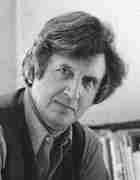

Jared Carter Biography
Jared Carter is a contemporary American poet born in Elwood, Indiana, in 1939. He studied at Yale and at Goddard College. After military service and travel abroad, he made his home in Indianapolis, where he has lived since 1969.
He worked for many years as an editor and interior designer of textbooks and scholarly works, first with the Bobbs-Merrill Company and later in association with Hackett Publishing Company.
Carter writes in free verse and in traditional forms. Much of his early work is set in " Mississinewa County, " an imaginary place that includes the actual Mississinewa River, a tributary of the Wabash River. In recent years, as he has published increasingly on the web, his poetry has ranged farther afield.
His poems have appeared in The New Yorker, The Nation, Poetry, and other journals in the U.S. and abroad. His work has been anthologized in Twentieth-Century American Poetry, Contemporary American Poetry, Writing Poems, and Poetry from Paradise Valley.
Carter’s accessible, surefooted poems have pleased critics and reviewers, many of whom do not stint on superlatives. Poet and critic Grace Cavalieri, writing in the Washington Independent Review of Books about Carter’s sixth collection, Darkened Rooms of Summer, said:
“Jared Carter writes the kind of poetry that death does not touch.... We trust this poet’s vision. He has a classic approach to poetry, a restoration of his own life and historical figures, as well.... The base roots are of nature, tradition, the common man doing ordinary things, and the historical past.”
Carter’s father and grandfather were general contractors. As he was growing up he worked alongside his father doing everything from roofing barns to building small rural bridges. Such a constructive background may have contributed to the fact that in his work he seems less interested in writing poetry and more concerned with making poems.
Overall, his approach is careful, eclectic, and patient. Poet and editor Anna Evans, writing in The Barefoot Muse about Carter’s fourth book, Cross this Bridge at a Walk, put it this way:
“[This book] will delight you... It may also remind you of something important about being a reader or writer of poetry: literary theories come and go; good poetry stays good forever.”
It takes a long, smooth stroke practiced carefully
over many years and made with one steady motion.
You do not really cut glass, you score its length
...
If you were fortunate enough to live
on a planet circling a sun-like star
in the Large Magellanic Cloud -
...
One of life's simplest moments: the approaching of the first few drops of a summer rain. That it was coming, all along, and had been predicted since mid-morning, by neighbors pointing to the dark western sky, and by the agitation of robins, and the unusual silence of cicadas - all that was conceded, and understood, while the rain itself would be welcomed, for it would cool the trees and the houses and the grass, and nourish the creatures of the earth in its invisible and lasting way.
Certainly it was expected, and yet as I sat there reading, being drawn into a faraway world, I had entirely forgotten the roof and the porch, and the parched streets, and even the increased tempo of the wind blowing through the trees - and suddenly there it was, that sound, those drops scattering, nothing overwhelming, just the announcement, the presence, of rain come at last.
...
In a cold empty room, down
in the basement, the janitor
had rigged up an old buffer
from the shoe factory - it was
...




Delivering Poems Around The World
Poems are the property of their respective owners. All information has been reproduced here for educational and informational purposes to benefit site visitors, and is provided at no charge...
4/4/2026 2:38:01 PM # 1.0.0