Jared Carter
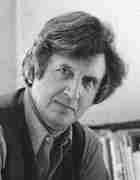

Jared Carter Poems
It takes a long, smooth stroke practiced carefully
over many years and made with one steady motion.
You do not really cut glass, you score its length
...
If you were fortunate enough to live
on a planet circling a sun-like star
in the Large Magellanic Cloud -
...
One of life's simplest moments: the approaching of the first few drops of a summer rain. That it was coming, all along, and had been predicted since mid-morning, by neighbors pointing to the dark western sky, and by the agitation of robins, and the unusual silence of cicadas - all that was conceded, and understood, while the rain itself would be welcomed, for it would cool the trees and the houses and the grass, and nourish the creatures of the earth in its invisible and lasting way.
Certainly it was expected, and yet as I sat there reading, being drawn into a faraway world, I had entirely forgotten the roof and the porch, and the parched streets, and even the increased tempo of the wind blowing through the trees - and suddenly there it was, that sound, those drops scattering, nothing overwhelming, just the announcement, the presence, of rain come at last.
...
In a cold empty room, down
in the basement, the janitor
had rigged up an old buffer
from the shoe factory - it was
...
No, it's simple, you mustn't worry.
She won't mind, you'll see when we get there,
it will be all right. She's never in a hurry.
...
It was never anything we really wanted to do.
There was always so damned many of them.
When we went out to milk, in the dark hours
of the morning, they'd swarm through the stalls,
...
I like their stories about snow -
how deep it got by spring. And nobody
would eat tomatoes, they were poison.
...
To balance there, again, in the early dark,
three rungs up on the old stepladder,
afraid to go any higher, it wobbles so -
to reach out and find the first set-screw
...
Our favorite? Not exactly. Still,
you made the rain
Of yellow shavings curl and spill
from your rough plane.
...
The old stories do not end the way you were told.
Hansel and Gretel do not escape from the witch's house;
they decide to stay. Ali Baba does not emerge from the cave,
but enters a subterranean chamber that goes on for miles.
...
To the memory of Bob Lewis, citizen of Rensselaer, Indiana
Not particularly afraid
of Death, I have always
...
One
Not that it matters now, but Silhouette himself
was not an artist, as most people seem to think -
...
You, who stood there eating spinach
in the garden,
Seemed so noble. When God finished
making you, sin
...
Home-made candles, each consisting of
the pith of a rush dipped in tallow.
to the memory of my father
...
There is a grace in the way people do things, even the simplest tasks-
the dance with which their fingers encircle the chicken's gaze, coaxing
the edges of its eyes into paleness, their calling upon it to rest now,
their speaking in a way that acknowledges something common to both of them-
...
When you drive at dusk, alone,
after the corn is harvested, the wind
scatters bits of dry husk along the road.
A farmer has draped a groundhog's carcass
...
Prolonged exposure to extremes of sun and heat can cause madness, even death, yet there is said to exist one group of nomads who roam the desert unceasingly. Its members have never been studied; only one thing is known about them.
Before leaving each campsite they mix quantities of sand with colors extracted from native wildflowers, and spread out a series of vast, intricate patterns. Such creations are obscured by the wind within minutes after the tribesmen ride away.
...
Fettered to benches where the oars were broken off long ago, they had no choice but to row with their hands. While they strained toward the water below, the chains cut welts in their limbs, and the brine inflamed their flesh.
But in time their arms became elongated, and their sores were healed by the sea. Some rowed backward, some rowed forward, some merely threshed the waves. Always they struggled, new and old oarsmen alike, and the galley sailed on like a graceful swan.
...
Was it you I saw, out burning off weeds along the ditch
north of the old house? You I glimpsed through the haze?
You standing there with your leaf rake, your watering can,
you who woke up this morning knowing there would be no wind,
...
Jared Carter Biography
Jared Carter is a contemporary American poet born in Elwood, Indiana, in 1939. He studied at Yale and at Goddard College. After military service and travel abroad, he made his home in Indianapolis, where he has lived since 1969. He worked for many years as an editor and interior designer of textbooks and scholarly works, first with the Bobbs-Merrill Company and later in association with Hackett Publishing Company. Carter writes in free verse and in traditional forms. Much of his early work is set in " Mississinewa County, " an imaginary place that includes the actual Mississinewa River, a tributary of the Wabash River. In recent years, as he has published increasingly on the web, his poetry has ranged farther afield. His poems have appeared in The New Yorker, The Nation, Poetry, and other journals in the U.S. and abroad. His work has been anthologized in Twentieth-Century American Poetry, Contemporary American Poetry, Writing Poems, and Poetry from Paradise Valley. Carter’s accessible, surefooted poems have pleased critics and reviewers, many of whom do not stint on superlatives. Poet and critic Grace Cavalieri, writing in the Washington Independent Review of Books about Carter’s sixth collection, Darkened Rooms of Summer, said: “Jared Carter writes the kind of poetry that death does not touch.... We trust this poet’s vision. He has a classic approach to poetry, a restoration of his own life and historical figures, as well.... The base roots are of nature, tradition, the common man doing ordinary things, and the historical past.” Carter’s father and grandfather were general contractors. As he was growing up he worked alongside his father doing everything from roofing barns to building small rural bridges. Such a constructive background may have contributed to the fact that in his work he seems less interested in writing poetry and more concerned with making poems. Overall, his approach is careful, eclectic, and patient. Poet and editor Anna Evans, writing in The Barefoot Muse about Carter’s fourth book, Cross this Bridge at a Walk, put it this way: “[This book] will delight you... It may also remind you of something important about being a reader or writer of poetry: literary theories come and go; good poetry stays good forever.”
The Best Poem Of Jared Carter
Cutting Glass
It takes a long, smooth stroke practiced carefully
over many years and made with one steady motion.
You do not really cut glass, you score its length
with a sharp, revolving wheel at the end of a tool
not much bigger than a pen-knife. Glass is liquid,
sleeping. The line you make goes through the sheet
like a wave through water, or a voice calling in a dream,
but calling only once. If the glazier knows how to work
without hesitation, glass begins to remember. Watch now
how he draws the line and taps the edge: the pieces
break apart like a book opened to a favorite passage.
Each time, what he finds is something already there.
In its waking state glass was fire once, and brightness.
All that becomes clear when you hold up the new pane.
First published in Yarrow.
Jared Carter Comments




Delivering Poems Around The World
Poems are the property of their respective owners. All information has been reproduced here for educational and informational purposes to benefit site visitors, and is provided at no charge...
10/24/2026 6:38:31 PM # rel_20261022T080914Z_e3039d4