
Miguel de Cervantes
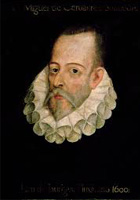

Miguel de Cervantes Poems
Rompí, corté, abollé, y dije e hice
más que en el orbe caballero andante;
fui diestro, fui valiente y arrogante,
...
¡Bien haya quien hizo
cadenitas, cadenas;
bien haya quien hizo
cadenas de amor!
...
A la guerra me lleva
mi necesidad;
si tuviera dineros
no fuera en verdad.
...
¿Quién menoscaba mis bienes?
¡Desdenes!
Y ¿quién aumenta mis duelos?
¡Los celos!
...
Voto a Dios que me espanta esta grandeza
y que diera un doblón por describilla;
porque ¿a quién no sorprende y maravilla
...
Bailan las gitanas,
míralas el rey;
la reina, con celos,
mándalas prender.
...
Vimos en julio otra Semana Santa
atestada de ciertas cofradías,
que los soldados llaman compañías,
de quien el vulgo, no el inglés, se espanta.
...
Miguel de Cervantes Biography
Diego Miguel de Cervantes Saavedra ( 29 September 1547 – 23 April 1616) was a Spanish novelist, poet, and playwright. His magnum opus Don Quixote, often considered the first modern novel, is a classic of Western literature, and is regularly regarded amongst the best novels ever written. His work is often considered amongst the most important works in all of Western literature. His influence on the Spanish language has been so great that Spanish is often called la lengua de Cervantes, Spanish for the language of Cervantes. He has been dubbed El Príncipe de los Ingenios – The Prince of Wits. Some of his poems are found in La Galatea. He also wrote Dos Canciones à la Armada Invencible. His best work however is found in the sonnets, particularly Al Túmulo del Rey Felipe en Sevilla. Among his most important poems, Canto de Calíope, Epístola a Mateo Vázquez, and the Viaje del Parnaso (Journey to Parnassus – 1614) stand out. The latter is his most ambitious work in verse, an allegory which consists largely of reviews of contemporary poets. Compared to his ability as a novelist, Cervantes is often considered a mediocre poet, although he himself always harbored a hope that he would be recognized for having poetic gifts.)
The Best Poem Of Miguel de Cervantes
Don Belianís De Grecia A Don Quijote De La Mancha
Rompí, corté, abollé, y dije e hice
más que en el orbe caballero andante;
fui diestro, fui valiente y arrogante,
mil agravios vengué, cien mil deshice.
Hazañas di a la fama que eternice;
fui comedido y regalado amante;
fue enano para mí todo gigante,
y al duelo en cualquier punto satisfice.
Tuve a mis pies postrada la Fortuna
y trajo del copete mi cordura
a la calva ocasión al estricote.
Mas, aunque sobre el cuerno de la luna
siempre se vio encumbrada mi ventura,
tus proezas envidio, ¡oh, gran Quijote!
Miguel de Cervantes Comments
Miguel de Cervantes - AKA Miguel de Cervantes Saavedra Born: 29-Sep-1547, in Alcalá de Henares, Spain Military service: Spanish Army (1570-75, wounded, sold into slavery) Died: 22-Apr-1616, in Madrid Cause of death: unspecified Remains: Buried, Convento de los Trinitarios, Madrid, Spain Father: Rodrigo de Cervantes (surgeon and barber) Mother: Leonor de Cortinas Brother: Andrés (b.1543) Sister: Andrea (b.1544) Sister: Luisa (b.1546) Brother: Rodrigo (b.1550) Sister: Magdalena (b.1554) Brother: Juan Wife: Catalina de Salazar y Palacios (m.12-Dec-1584, until his death) Daughter: Isabel de Saavedra (b.1584, with de Rojas) Mistress: Ana Franca de Rojas (affair, one daughter) His books: Primera Parte de la Galatea (1585, novel) El Ingenioso Hidalgo Don Quixote de la Mancha (1605, novel) Novelas Exemplares (1613, short stories) Viage del Parnaso (1614, poetry) Segunda Parte del Ingenioso Cavallero Don Quixote de la Mancha (1615, novel) Los Trabaios de Persiles y Sigismunda, Historia Setentrional (1617, novel)
6. In 1609 he joined the newly founded confraternity of the Slaves of the Most Blessed Sacrament; in 1610 Lemos was appointed viceroy of Naples, and Cervantes was keenly disappointed at not being chosen to accompany his patron. In 1611 he lost his sister Magdalena, who was buried by the charity of the Tertiaries of Saint Francis; in 1612, he joined the Academia Selvaje, and there appears to have renewed his former friendly relations with Lope de Vega; in 1613 he dedicated his Novelas exemplares to the count de Lemos, and disposed of his rights for 1600 reales and twenty-four copies of the book. The twelve tales in this volume, some of them written very much later than others, are of unequal merit, but they contain some of the writer's best work, and the two picaresque stories - Rinconete y Cortadillo and the Coloquio de los perros - are superb examples of their kind, and would alone entitle Cervantes to take rank with the greatest masters of Spanish prose. In 1614 he published the Viage del Parnaso, a burlesque poem suggested by the Viaggio in Parnaso (1582) of the Perugian poet Cesare Caporali. It contains some interesting autobiographical passages, much flattery of contemporary poetasters, and a few happy satirical touches; but, though it is Cervantes' most serious bid for fame as a poet, it has seldom been reprinted, and would probably have been forgotten but for an admirably humorous postscript in prose which is worthy of the author at his best. In the preface to his Ocho comedies y echo entremeses nuevos (1615) he good-humoredly admits that his dramatic works found no favor with managers, and, when this collection was first reprinted (1749) , the editor advanced the fantastic theory that the comedias were deliberate exercises in absurdity, intended to parody the popular dramas of the day. This view cannot be maintained, but a sharp distinction must be drawn between the eight set plays and the eight interludes; with one or two exceptions, the comedias or set plays are unsuccessful experiments in Lope de Vega's manner, while the entremeses or interludes, particularly those in prose, are models of spontaneous gaiety and ingenious wit.
some interesting facts about Cervantes: 1. It had become evident that Cervantes could not gain his bread by literature, and in 1587 he went to Seville to seek employment in connection with the provisioning of the invincible Armada. He was placed under the orders of Antonio de Guevara, and before the 24th of February was excommunicated for excessive zeal in collecting wheat at Écija. During the next few months he was engaged in gathering stores at Seville and the adjacent district, and after the defeat of the Armada he was retained as commissary to the galleys. Tired of the drudgery, and without any prospect of advancement, on the 21st of May 1590 Cervantes drew up a petition to the king, recording his services and applying for one of four posts then vacant in the American colonies: a place in the department of public accounts in New Granada, the governorship of Soconusco in Guatemala, the position of auditor to the galleys at Cartagena, or that of corregidor in the city of La Paz. The petition was referred to the Council of the Indies, and was annotated with the words: Let him look for something nearer home. Cervantes perforce remained at his post; the work was hard, uncongenial and ill-paid, and the salary was in constant arrears. In November 1590 he was in such straits that he borrowed money to buy himself a suit of clothes, and in August 1592 his sureties were called upon to make good a deficiency of 795 reales in his accounts. His thoughts turned to literature once more, and on the 5th of September 1592, he signed a contract with Rodrigo Osorio undertaking to write six plays at fifty ducats each, no payment to be made unless Osorio considered that each of these pieces was one of the best ever produced in Spain. Nothing came of this agreement, and it appears that, between the date of signing it and the 19th of September, Cervantes was imprisoned (for reasons unknown to us) at Castro del Río. He was speedily released, and continued to perquisition as before in Andalusia; but his literary ambitions were not dead, and in May 1595 he won the first prize - three silver spoons - at a poetical tourney held in honor of St. Hyacinth at Saragossa. (to be continued)
2. Shortly afterwards Cervantes found himself in difficulties with the exchequer officials. He entrusted a sum of 7400 reales to a merchant named Simón Freire de Lima with instructions to pay the amount into the treasury at Madrid; the agent became bankrupt and absconded, leaving Cervantes responsible for the deficit. By some means the money was raised, and the debt was liquidated on the 21st of January 1597. But Cervantes' position was shaken, and his unbusinesslike habits lent themselves to misinterpretation. On the 6th of September 1597 he was ordered to find sureties that he would present himself at Madrid within twenty days, and there submit to the exchequer vouchers for all official moneys collected by him in Granada and elsewhere. No such sureties being available, he was committed to Seville jail, but was released on the 1st of December on condition that he complied with the original order of the court within thirty days. He was apparently unable to find bail, was dismissed from the public service, and sank into extreme poverty. During a momentary absence from Seville in February 1599, he was again summoned to Madrid by the treasury, but does not appear to have obeyed: it is only too likely that he had not the money to pay for the journey. There is some reason to think that he was imprisoned at Seville in 1602, but nothing positive is known of his existence between 1600 and the 8th of February 1603: at the latter date he seems to have been at Valladolid, to which city Philip III had removed the court in 1601.
Kelrepa denovxcur vonvdf meklereawsdit hifvcirst trodfurbs!
___________________________ 2016 has been named ''the year of Shakespeare & Cervantes'', since they died 400 years ago (***April 1616) and to underline how much the two writers have in common. ***Indeed, they died almost in the same day: both writers were traditionally thought to have died on April 23 (and for this reason this day became World Book Day) . ___________________________
Miguel de Cervantes Quotes
'Tis ill talking of halters in the house of a man that was hanged.
Tell me thy company, and I'll tell thee what thou art.
My old grannum (rest her soul) was wont to say, there were but two families in the world, have-much and have-little.
There's no sauce in the world like hunger.
The bow cannot always stand bent, nor can human frailty subsist without some lawful recreation.
It seldom happens that any felicity comes so pure as not to be tempered and allayed by some mixture of sorrow.
Alas! all music jars when the soul's out of tune.
The eyes those silent tongues of love.
He is mad past recovery, but yet he has lucid intervals.
You are a king by your own fireside, as much as any monarch in his throne.
Truth indeed rather alleviates than hurts, and will always bear up against falsehood, as oil does above water.
'Tis the only comfort of the miserable to have partners in their woes.
There is a strange charm in the thoughts of a good legacy, or the hopes of an estate, which wondrously removes or at least alleviates the sorrow that men would otherwise feel for the death of friends.
That which costs little is less valued.
Every man is the son of his own works.
Love and war are the same thing, and stratagems and policy are as allowable in the one as in the other.
I have always heard, Sancho, that doing good to base fellows is like throwing water into the sea.
A private sin is not so prejudicial in this world, as a public indecency.
One of the most considerable advantages the great have over their inferiors is to have servants as good as themselves.
For a man to attain to an eminent degree in learning costs him time, watching, hunger, nakedness, dizziness in the head, weakness in the stomach, and other inconveniences.
Delay always breeds danger; and to protract a great design is often to ruin it.
I do not say a proverb is amiss when aptly and reasonably applied, but to be forever discharging them, right or wrong, hit or miss, renders conversation insipid and vulgar.
Modesty, 'tis a virtue not often found among poets, for almost every one of them thinks himself the greatest in the world.
Our greatest foes, and whom we must chiefly combat, are within.
I believe there's no proverb but what is true; they are all so many sentences and maxims drawn from experience, the universal mother of sciences.
By such innovations are languages enriched, when the words are adopted by the multitude, and naturalized by custom.
There is nothing so subject to the inconstancy of fortune as war.
When the severity of the law is to be softened, let pity, not bribes, be the motive.
Virtue is the truest nobility.
What I say is, patience, and shuffle the cards.
A closed mouth catches no flies.
There's no taking trout with dry breeches.
'Tis a dainty thing to command, though 'twere but a flock of sheep.
Mere flim-flam stories, and nothing but shams and lies.
To withdraw is not to run away, and to stay is no wise action, when there's more reason to fear than to hope.
Well, there's a remedy for all things but death, which will be sure to lay us flat one time or other.
Hold you there, neither a strange hand nor my own, neither heavy nor light shall touch my bum.




Delivering Poems Around The World
Poems are the property of their respective owners. All information has been reproduced here for educational and informational purposes to benefit site visitors, and is provided at no charge...
4/6/2026 4:38:16 AM # 1.0.0



8. The first part of Don Quixote had been reprinted at Madrid in 1608; it had been produced at Brussels in 1607 and 1611, and at Milan in 1610; it had been translated into English in 1612 and into French in 1614. Corvantes was celebrated in and out of Spain, but his celebrity had not brought him wealth. The members of the French special embassy, sent to Madrid in February 1615, under the Commandeur de Sillery, heard with amazement that the author of the Galatea, the Novelas exemplares and Don Quixote was old, a soldier, a gentleman and poor. But his trials were almost at an end. Though failing in health, he worked assiduously at Los Trabajos de Persiles y Sigismunda, which, as he had jocosely prophesied in the preface to the second part of Don Quixote, would be either the worst or the best book ever written in our tongue. It is the most carefully written of his prose works, and the least animated or attractive of them; signs of fatigue and of waning powers are unmistakably visible. Cervantes was not destined to see it in print. He was attacked by dropsy, and, on the 18th of April 1616, received the sacrament of extreme unction; next day he wrote the dedication of Persiles y Sigismunda to the count de Lemos - the most moving and gallant of farewells. He died at Madrid in the Calle del León on the 23rd of April; he was borne from his house with his face uncovered, according to the rule of the Tertiaries of St. Francis, and on the 24th of April was buried in the church attached to the convent of the Trinitarian nuns in the Calle de Cantarranas. There he rests - the story of his remains being removed in 1633 to the Calle del Humilladero has no foundation in fact - but the exact position of his grave is unknown. Early in 1617 Persiles y Sigismunda was published, and passed through eight editions within two years; but the interest in it soon died away, and it was not reprinted between 1625 and 1719. Cervantes' wife died without issue on the 31st of October 1626; his natural daughter, who survived both the child of her first marriage and her second husband, died on the 20th of September 1652. Cervantes is represented solely by his works. The Novelas exemplares alone would give him the foremost place among Spanish novelists; Don Quixote entitles him to rank with the greatest writers of all time: children turn its leaves, young people read it, grown men understand it, old folk praise it. It has outlived all changes of literary taste, and is even more popular today than it was centuries ago.