
Yosa Buson
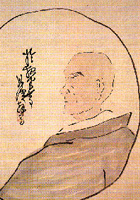

Yosa Buson Poems
Spring
The year's first poem done,
with smug self confidence
...
Before the white chrysanthemum
the scissors hesitate
a moment.
...
Not quite dark yet
and the stars shining
above the withered fields.
...
My arm for a pillow,
I really like myself
under the hazy moon.
...
Listening to the moon,
gazing at the croaking of frogs
in a field of ripe rice.
...
You left in the morning, at evening my heart is in a
thousand pieces.
Why is it so far away?
...
Yosa Buson Biography
Leading haiku poet of the late 18th century and, with Basho and Issa, one of the great names in haiku. Also known as Yosa Buson or Taniguchi Buson. Also a distinguished Bunjinga(literati-style) painter, he perfected haiga ("haiky sketch") as a branch of Japanese pictorial art. His best-known painting disciple, Matsumura Goshun, also known as Gekkei, founded the Shijo school. Born near Osaka, as a youth Buson went to Edo (now Tokyo). For five years (1737-42) he belonged to a haikai linked-verse circle over which Hayano Hajin (1676-1742) presided. Here he learned the traditions of the Basho school haikai as transmitted by Hattori Ransetsu and Takarai Kikaku. After Hajin's death Buson spent much time around Yuki, north of edo, where he painted, practiced haikai, and worte Hokuju Rosen wo itamu (Elegy to the old poet Hokuju), the first of his innovative poems that foreshadow modern free verse. Buson also visited places in northeastern Japan famed in Basho's poetic diary, Oku No Hosomichi (1694; tr The Narrow Road to the Deep North, 1966). Buson settled in Kyoto in the late 1750s. He was active in Mochizuki Sooku's (1688-1766) poetry circle and was also actively painting in the Chinese-inspired bunjinga style. By practicing both poetry and painting, he aspired to the ideals of the bunjin (Ch: wen-ren or wen-jen; literati) of China. One of Buson's commissions involved collaborating with Ike No Tagia on a landscape series based on Chinese poems, Juben jugi (1771, Ten Conveniences and Ten Pleasures), now a National Treasure. In 1770 he took the name of Yahantei the Second (Midnight Hermitage) for his studio. His haikai teacher Hajin was the First Yahantei. In painting, he used the names of Sha Cho-Koh, Shunsei (Spring Star) and others during his earlier years in Kyoto. Master of Poetry and Painting - Buson found his distinct voice partly from association with two dissimilar poets, Tan Taigi and Kuroyanagi Shoha (d 1772), both of whom helped him develop his spontaneous and sensual style. Following their passing, Buson emerged as the central figure of a haikai revival known as the "Return to Basho" movement. In 1776 his own poetry group built a clubhouse, the Bashoan (Basho Hut), for their haikai and linked-verse gatherings. Buson also prepared several illustrated scrolls and screens, including the text of Oku no hosomich, which helped canonize Basho as a grand saint of poetry. Although Buson sought to emulate Basho, his own poetry is clearly different and versatile. Buson read classics extensively and studied different styles of Chinese and Japanese paintings. Poetry and painting affected each other in his art. His poems were, diversely enough, rich in imagery, clearly depicting fine movements and sensual appearances of things, dynamic with wider landscapes, lyrical, sensitive to human affairs, romantic with hidden stories, graceful, and longingly time-conscious. Buson completed his own style of painting in his later years when he was using the name of Sha-In. Freed from the influence of China, he created genuine Japanese landscapes.)
The Best Poem Of Yosa Buson
Coolness
Coolness--
the sound of the bell
as it leaves the bell.
Translated by Robert Hass
Yosa Buson Comments
Wrote Yosa Buson: '' Leaders of the haikai circles today each advocate their own poetic styles and speak ill of all the other styles. extending their elbows and puffing up their cheeks, they declare themselves to be master poets. Some try to appeal to the wealthy, others to the eccentric, but most of the verses selected in their anthologies are unrefined works, the kind of verses that would make knowledgeable experts cover their eyes at the first glance and throw them away. ''
Masaoka Shiki believed Yosa Buson was the greatest haiku poet
nicely simple, lovable, and memorable for the people who appreciate the simple things




Delivering Poems Around The World
Poems are the property of their respective owners. All information has been reproduced here for educational and informational purposes to benefit site visitors, and is provided at no charge...
4/6/2026 6:03:05 PM # 1.0.0



'' The hokku composed after the death of Basho had its ups and down '', but luckily, Yosa Buson and Kobayashi Issa [and others] took their art seriously. Wrote Yosa Buson: '' Leaders of the haikai circles today each advocate their own poetic styles and speak ill of all the other styles. extending their elbows and puffing up their cheeks, they declare themselves to be master poets. Some try to appeal to the wealthy, others to the eccentric, but most of the verses selected in their anthologies are unrefined works, the kind of verses that would make knowledgeable experts cover their eyes at the first glance and throw them away. ''