
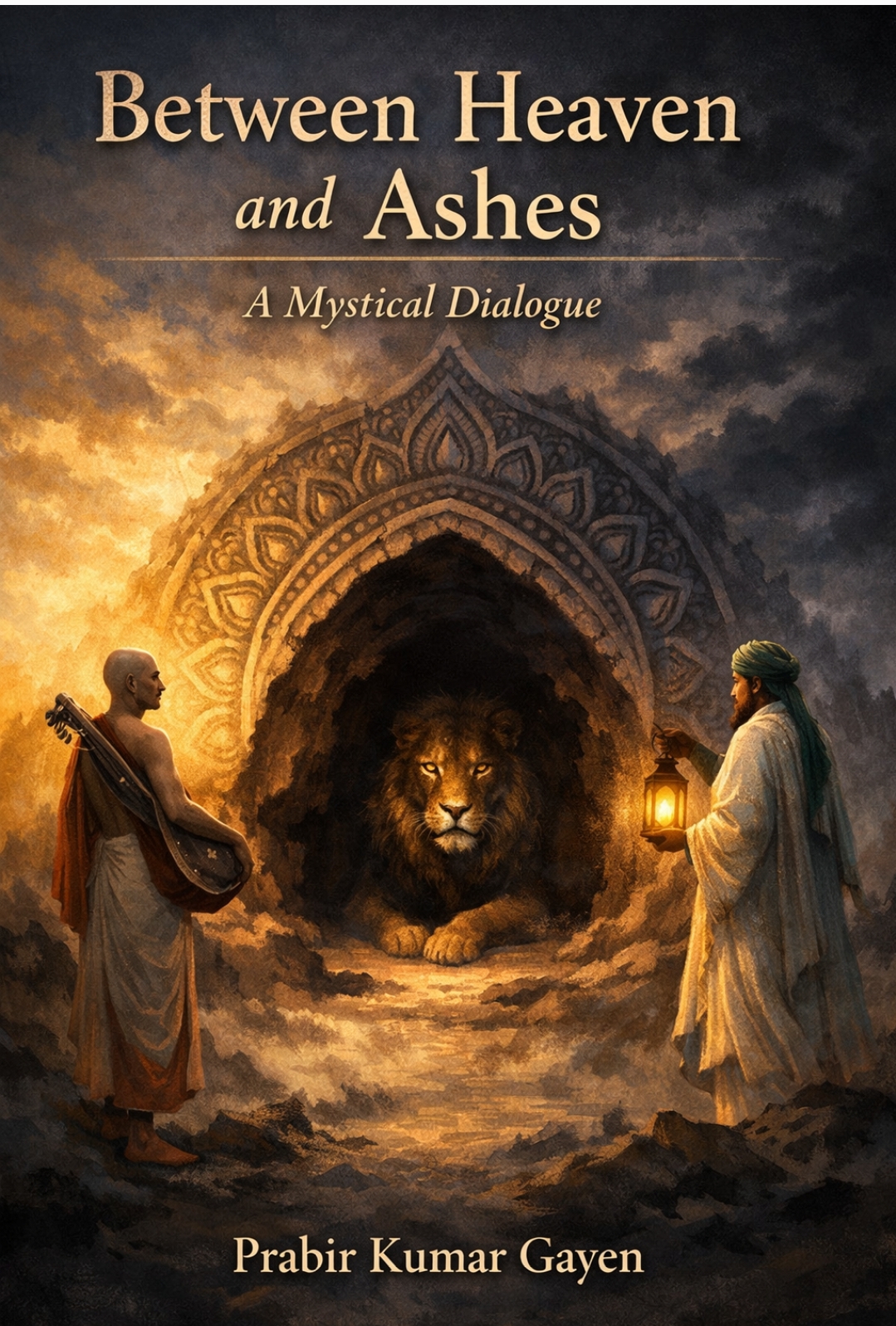
Between Heaven And Ashes (A Mystical Dialogue) Poem by Prabir Gayen


Between Heaven And Ashes (A Mystical Dialogue)
Between Heaven and Ashes
(A Mystical Dialogue)
Prabir Kumar Gayen
In a realm
neither heaven nor hell,
a threshold where silence still remembers sound,
a Hindu monk walked barefoot
after leaving behind
his mortal cloth,
his saffron worn thin by renunciation.
He had dissolved himself
in long-rooted samādhi,
where breath forgets the body
and bliss flows without cause.
Music lived in his veins;
a veena strummed by the unseen.
Awakened,
he wandered a celestial meadow
washed in neither fire nor light,
when he met a Sufi saint
standing still as a wound in time.
The monk's presence
perfumed the air with peace;
the saint's eyes carried
the grief of the earth.
"Brother, " said the monk,
voice steeped in the Upanishads,
"Why does sorrow cling to you
in this stainless realm? "
The Sufi smiled,
not with joy, but with burden,
and said,
"I am thinking of the fate of humankind,
of civilizations that sleep
while history sharpens its teeth."
The monk spoke of Sanātana Dharma,
of knowledge older than memory,
of paths that spiral into infinity,
of a culture that taught the world
to breathe together.
But the Sufi lifted his hand,
and the sky itself became a mirror.
He showed the ground-reality of Earth.
"Hindu homes, " he said,
"built by tireless hands—
fathers bending under years of labour,
mothers stitching tomorrow
into their children's bones.
They raise doctors, engineers, scholars,
architects of reason,
gardeners of compassion.
They preach coexistence,
universal kinship,
gentleness as strength.
Yet beside them grow
forces that do not build,
only multiply.
For them, certainty replaces inquiry,
numbers replace wisdom,
faith replaces conscience.
Tell me, "
the Sufi asked softly,
"who is wiser—
those who question and create,
or those who obey and expand? "
The monk's silence deepened.
The vision continued:
"Houses rise like prayers,
cities bloom like scriptures,
yet unseen eyes count them,
not as homes,
but as future claims.
History has whispered this before.
Kingdoms forged by patience
were taken by ferocity.
Libraries burned by those
who feared thought.
Temples, monasteries, gurudwaras,
not defeated by weakness,
but by disunity.
The gentle were not wrong,
only alone."
The Sufi's voice trembled,
not with anger,
but with grief:
"They who divide themselves
by caste, by sect, by pride,
‘my guru higher than yours, '
‘my truth purer than yours',
forget that fragmentation
is the first surrender.
A lion asleep in a cave
still starves."
The Hindu monk wept,
not from insult,
but from recognition.
"I taught non-violence, " he said,
"without courage.
I taught the Gita
without its fire."
And in that moment
the scripture turned living flame:
The Gita is not weakness.
Nor cruelty.
It is balance—
wisdom armed with resolve.
It is the courage to stand united
against the brute-force of ignorance.
It is not for cowards,
nor for killers,
but for guardians of dharma.
Now both saints—
born of different prayers
but the same ache,
stood together
in a silence heavier than meditation.
They did not chant.
They did not fight.
They thought.
How to awaken
a sleeping civilization.
How to teach unity
without erasing diversity.
How to remind the gentle
that compassion without vigilance
is self-erasure.
The earth below trembled,
not yet destroyed,
but undecided.
And a question drifted
like a final bell:
Which way are we walking,
toward awakening,
or toward a beautifully decorated oblivion?
@Prabir Gayen
Dce 21/20225/4: 12 PM.
Note: You are making buildings for those who are multiplying in number and Waiting for right time.
Unite or be wiped out.
This poem has not been translated into any other language yet.
I would like to translate this poem



Delivering Poems Around The World
Poems are the property of their respective owners. All information has been reproduced here for educational and informational purposes to benefit site visitors, and is provided at no charge...
3/26/2026 2:26:54 AM # 1.0.0



Wow! I especially liked the line: A lion asleep in a cave still starves.