
Ayyappan 19 - The Long Arduous Pilgrimage To Sabarimala Poem by Geeta Radhakrishna Menon


Ayyappan 19 - The Long Arduous Pilgrimage To Sabarimala
When Lord Ayyappan seated Himself
Atop the hills of Sabarimala,
A stream of his devotees began the climb to Sabarimala.
The royal family made their compulsory annual pilgrimage,
A trip to the temple to pay their loving respects,
To get a glimpse of their ever-merciful Lord Ayyappan.
So did the countless devotees and ardent followers,
That kept increasing year after year.
With a strict code of conduct and ethics,
Prescribed for the annual pilgrimage to the temple.
Each pilgrim had to follow the rules and rituals,
Laid down for the worship of this celibate God.
The pilgrimage to Sabarimala
Began with a forty-one days ‘Vratam' or Fast.
A walk through the thick jungles inhabited
By wild animals and thorny shrubs,
A climb through the uneven grounds, ditches,
A dangerous path taken by generations of worshippers!
The devotees set out
On a long journey to the Sabarimala,
With ‘Irumudikettu' placed on their heads-
A cloth bag tied into two portions,
Consisting of coconut filled with ghee
and other articles of worship.
Singing and chanting loudly in praise of Lord Ayyappa,
The pilgrims walk and walk, until they reach Erumeli.
This is the place of their first halt after a long tread.
Erumeli is famed for the Shasta Ayyappan temple,
Constructed by Rajasekhara, the King of Panthala.
Here, the idol is in the form of a hunter with bow and arrows.
Next is the Vavar Shrine,
Where the devotees stop,
To receive the sacred ash from the Muslim priest.
Vavar was Ayyappan's best friend and a faithful follower.
Sabarimala is a temple where people of all religions
Congregate to pray and pay their respects to Ayyappan.
Further, the devotees proceed on until they reach Petta!
In Petta, the devotees perform a vibrant kind of dance-
Popularly known as ‘Petta Thullal'!
They sing in loud chorus and vigorous rhythmic beats.
"Swami Tintakatom Ayyappa Tintakatom"!
This dance is in memory of the holy dance of Manikantan on Mahishi.
Soon after Petta thullal, the devotees arrive at Kottapadi -
The holy garden of Lord Ayyappan.
On the banks of river Azutha, the pilgrims have their bath and rest.
Refreshed by the cool river and fresh air of the valley,
They proceed picking up stones from the river.
These stones are dropped, when they climb the next Kallidamkunnu.
Further up, the pilgrims reach Karimala.
The soil is black here inhabited by wild animals.
It is a hard and strenuous climb to the top.
Having covered a distance of forty miles through hills, valleys and woods,
The devotees reach the banks of the holy river Pamba,
As sacred as river Ganga for the Keralites!
A day's rest and worship at Pamba River,
Alms to the poor and needy,
A must before proceeding atop the hill of Karimala.
A little distance ahead is Sabaripeetom,
Where saint Sabari observed severe penance and
Attained ‘Moksha' at the hands of Lord Rama.
A performance, a memory, a biography,
An experience as a dancer.
This is an extract from my book
"Mohiniattam -The Dance of the Enchantress"
Part 2 -The Choreographies entitled "Swamiye Saranam Ayyappa".
This prose poem is an edited version
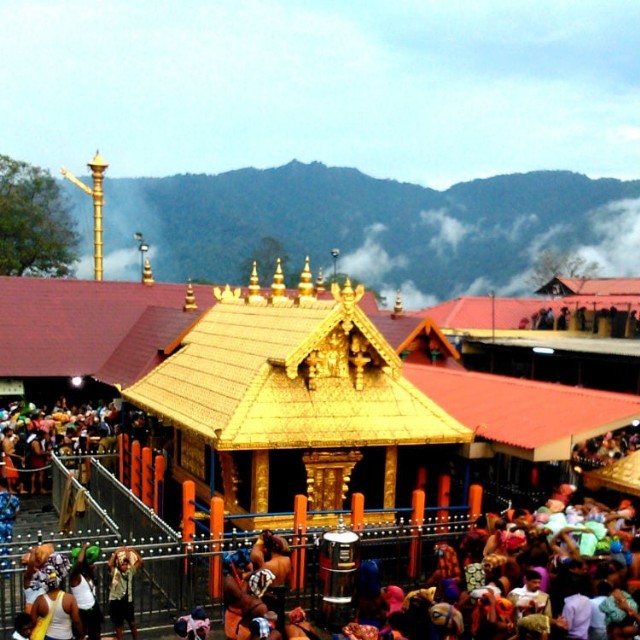
Lord Ayyappan is a popular deity of Kerala, worshipped by countless devotees in South India. An annual pilgrimage to the Ayyappan temple involves a strict code of conduct besides following the rituals on a long and arduous journey to the temple of Sabarimala.
The image of Sabarimala temple with devotees. Photo Courtesy: Internet
It is interesting to note that the annual pilgrimage 'involves a strict code of conduct besides following the rituals on a long and arduous journey to the temple of Sabarimala'. All the holy places en route have been mentioned along with their relevance vis-a-vis the Lord. Thank you so much, Geeta ji. It reads like doing a pilgrimage.
A stream of his devotees began the climb to Sabarimala and royal family declared the visits of pilgrimage. A day's rest and worship at Pamba River motivated many to visit. This is an excellent and informative devotional poem shared here.10
The other day I read a poem on Lord Ayyappan riding leopard! This is another sublime work unfolding magnificent details of pilgrimage to the Ayyappan temple! A very commendable series....10
This poem has not been translated into any other language yet.
I would like to translate this poem



Delivering Poems Around The World
Poems are the property of their respective owners. All information has been reproduced here for educational and informational purposes to benefit site visitors, and is provided at no charge...
4/4/2026 4:49:46 PM # 1.0.0



Fascinating view on the complex rituals of a pilgrimage to a sacred destination.